


Psychosocial burden and lifestyle impact in patients with renal cell carcinoma: a patient-reported outcomes analysis


Abstract
Background
Psychosocial experiences in renal cell carcinoma (RCC) are incompletely characterized by patient-reported data. We described emotional, behavioral, and social experiences among patients with RCC participating in an online wellbeing survey.
Methodology
This cross-sectional secondary analysis included 91 respondents from the Russian Federation who completed the nine-item International Kidney Cancer Coalition (IKCC) Personalised Psychosocial Wellbeing Report survey during the World Kidney Cancer Day 2021 campaign. Item responses were summarized as counts and percentages; selected proportions are presented with Wilson 95% confidence intervals.
Results
Of 91 respondents, 52 (57%) were women; 43 (47%) reported metastatic disease, 29 (32%) had undergone local treatment for localized/locally advanced disease, and 16 (18%) were under surveillance. Emotional distress responses were selected by 44 (48%), and 50 (55%) reported recurrence/progression worry with associated distress. In separate items, 29 (32%) preferred not to discuss emotions and 45 (49%) avoided disclosure because they did not want to appear weak or be pitied; overlap between these responses could not be determined. Sleep disturbance was reported by 56 (62%), and 34 (37%) reported little or no physical activity. Relationship strain or deliberate distancing was reported by 32 (35%).
Conclusions
Psychosocial and lifestyle concerns were common in this self-selected online RCC cohort. The findings support routine attention to emotional concerns and communication barriers while remaining descriptive because the survey was not a validated psychometric instrument.
Keywords: Renal cell carcinoma, psychosocial burden, patient-reported outcomes, fear of recurrence, quality of life, survivorship, oncology supportive care.
Introduction
Renal cell carcinoma (RCC) has undergone a marked change in clinical trajectory as advances in surgery and systemic therapy have extended survival for patients with both localized and metastatic disease1,2. Longer survival increases the importance of understanding how patients live with uncertainty, treatment burden, surveillance, and the possibility of recurrence or progression.
Psychosocial concerns are common in kidney cancer. International patient surveys have documented disease-related anxiety, fear of recurrence or progression, depression, communication difficulties, and unmet supportive-care needs, with substantial variation between countries and disease stages3,4. Recent results from the 2025 IKCC Global Patient Survey, reported in 2026, similarly indicate that emotional concerns remain frequent across kidney cancer stages and that many patients do not discuss these concerns with healthcare professionals5. These observations emphasize that patient experience is shaped not only by disease status but also by communication, social context, and access to supportive care.
The present study aimed to describe item-level psychosocial, behavioral, and social responses among patients with RCC from the Russian Federation who completed an online wellbeing questionnaire. Because the instrument was designed as an awareness and conversation-support tool rather than a diagnostic or validated psychometric scale, the analysis was intentionally descriptive and did not estimate the prevalence of psychiatric disorders or formal quality-of-life constructs.
Materials and Methods
Study design and data source
This was a cross-sectional secondary expanded analysis of anonymized responses from the Russian Federation collected through the International Kidney Cancer Coalition (IKCC) Personalised Psychosocial Wellbeing Report (PPWR), an online resource developed for the World Kidney Cancer Day campaign. The global campaign invited people living with kidney cancer in participating countries to complete a short online survey and receive a personalized one-page wellbeing report. IKCC reported 712 completed PPWRs globally in 14 languages. The PPWR was intended to increase awareness and facilitate conversations about psychosocial wellbeing and was explicitly not designed as a clinical diagnostic instrument6.
The questionnaire was developed by IKCC for the campaign, with clinical input reported from a clinical and health psychologist, and consisted of nine structured questions. It was not a formally validated psychometric instrument. The present analysis included all 91 respondents from the Russian Federation available in the dataset who completed the same nine-item PPWR questionnaire. To our knowledge, this specific Russian Federation PPWR cohort and its item-level responses have not previously been reported in a peer-reviewed publication and do not overlap with the cohort analyzed3.
Participation was voluntary and online. RCC diagnosis, disease status, and histologic subtype were self-reported and were not independently verified. The analytic dataset did not contain identifiers.
The source materials available for this secondary analysis did not retain the number of individuals who accessed or started the questionnaire, exact survey opening and closing dates, technical procedures for preventing duplicate entries, or information on incentives; therefore, a response/completion rate cannot be calculated. These limitations are reported explicitly in accordance with the principles of transparent reporting for web-based surveys.
Survey instrument
The nine forced-choice items addressed: (1) emotional and cognitive responses to cancer; (2) reactions to cancer-related information; (3) fear of recurrence; (4) future outlook and adaptation; (5) preferred source of emotional support; (6) barriers to emotional communication; (7) sleep changes; (8) weekly physical activity; and (9) impact on relationships. Each item offered four mutually exclusive response options. Physical-activity response categories were expressed as hours per week, exercise intensity was not specified, so the responses cannot be mapped reliably to the World Health Organization threshold for moderate-intensity activity.
Participants and missing data
All respondents in the Russian subset who had completed the questionnaire were included. In the aggregate dataset, response counts for each of the nine survey items summed to 91. Therefore, no item-level missing responses were evident. Individual respondent-level records linking questionnaire responses to demographic or clinical characteristics were not available for this secondary analysis. The cohort included patients across disease states, including surveillance, previously treated localized/locally advanced disease, and metastatic disease.
Statistical analysis
Analyses were descriptive. Categorical responses were summarized as n (%), with percentages calculated directly from raw counts using total number of patients as the denominator and rounded to the nearest whole percentage in the text and table. No composite psychometric scores were calculated. Descriptive groupings defined for this analysis were created from response categories: emotional distress (overwhelmed or racing worries), recurrence/progression worry with associated distress (greatest fear or worry a few times per month), sleep disturbance (sleeping less, sleeping more, or difficulty falling/staying asleep), and minimal physical activity (little or none). The two communication outcomes were retained as separate items; their overlap is unknown. Wilson score 95% confidence intervals were calculated for the six displayed binomial proportions. Statistical analyses were performed using IBM SPSS Statistics version 22.0 (IBM Corp., Armonk, NY, USA). No hypothesis testing or imputation was performed.
Ethics and consent
The original PPWR was an anonymous patient-awareness and conversation-support initiative rather than an interventional clinical study. No institutional ethics committee approval or formal waiver was documented in the source materials available for this secondary analysis. The present analysis used anonymized, non-identifiable data only. Participation in the online questionnaire was voluntary, written informed consent was not collected, and completion of the questionnaire constituted implied consent to participation in the campaign.
Results
Patient characteristics
A total of 91 respondents were included; 52 (57%) were women. Clear-cell RCC was reported by 74 (81%), non-clear-cell RCC by 5 (5%), another histologic type by 5 (5%), and 7 (8%) did not know their subtype. At the time of the survey, 43 (47%) reported metastatic disease, 29 (32%) reported localized or locally advanced RCC treated with surgery or another local therapy, 16 (18%) were under surveillance, and 3 (3%) reported another disease status. The female majority differs from the usual male predominance of RCC and is relevant when considering selection and generalizability. The complete distribution of responses to all nine survey items is presented in Table 1.
Table 1. Psychosocial, behavioral, and social outcomes in RCC patients, N = 91
| Question/domain | Response | n (%) |
|---|---|---|
| Q1. Emotional and cognitive response to cancer | I often feel overwhelmed, defeated and unable to do everyday activities | 22 (24) |
| I experience racing worries and thoughts that interfere with my concentration | 22 (24) | |
| Thinking about my cancer sometimes causes anxiety but I do not let it overwhelm me | 31 (34) | |
| I feel confident about my medical care and my ability to cope, so I mostly manage to stay calm | 16 (18) | |
| Q2. Reaction to cancer-related information | It reminds me of my cancer; I feel anxious and worry about my future health | 16 (18) |
| It reminds me of my cancer; I resent that it happened and I am not the same person I was before | 24 (26) | |
| It reassures me that I am not alone and that much is being done to prevent and treat cancer | 41 (45) | |
| It is just an advertisement; it is unlikely to affect me | 10 (11) | |
| Q3. Fear of recurrence | It is one of my greatest fears; I think about it most days | 26 (29) |
| I worry about it a few times a month and it can make me anxious or depressed | 24 (26) | |
| I think about it occasionally but I am not overwhelmed by it | 31 (34) | |
| I know it can happen but fear of recurrence is not a concern for me | 10 (11) | |
| Q4. Future outlook and adaptation | My cancer has changed everything; my life feels meaningless and hopeless | 7 (8) |
| I feel defeated; I have lost interest and motivation in many things that used to give me pleasure | 12 (13) | |
| I know I need to stay positive; it is not always easy but I am not going to let it get me down | 43 (47) | |
| Life after kidney cancer will be different, but it can still be full of good things | 29 (32) | |
| Q5. Preferred emotional support | Doctors, oncology team, or other cancer care professionals | 24 (26) |
| Spouse, partner, close family, or friends | 7 (8) | |
| Other kidney cancer patients | 31 (34) | |
| I prefer not to talk about how my cancer is making me feel | 29 (32) | |
| Q6. Barriers to emotional communication | I feel bad about being needy or a burden on family and friends | 3 (3) |
| I do not want to appear weak or for others to pity me | 45 (49) | |
| I know I need their support and they are happy to give it | 19 (21) | |
| I am uncomfortable talking about emotions, so I tend to say nothing | 24 (26) | |
| Q7. Sleep changes | I am sleeping less than I used to; sometimes I lie awake for hours | 29 (32) |
| I am sleeping more than I used to; I am always tired and sometimes struggle to get out of bed | 12 (13) | |
| I have difficulty falling and staying asleep as my thoughts will not stop racing | 15 (16) | |
| My sleep patterns are generally as they were before diagnosis | 35 (38) | |
| Q8. Weekly physical activity | Little or none | 34 (37) |
| Up to 2.5 hours | 19 (21) | |
| 2.5 to 5 hours | 22 (24) | |
| More than 5 hours | 16 (18) | |
| Q9. Impact on relationships | Facing cancer with support of family and close friends has brought us closer | 10 (11) |
| Cancer-related stress and uncertainty have taken a toll on my relationships | 16 (18) | |
| I have consciously distanced myself to avoid upsetting family and close friends | 16 (18) | |
| Relationships with family and close friends are much as before diagnosis | 49 (54) |
Percentages may not total 100% because of rounding.
Emotional experience, recurrence concerns, and future outlook
For the emotional/cognitive item, 22 (24%) respondents selected feeling overwhelmed and unable to perform everyday activities, and 22 (24%) selected racing worries that interfered with concentration. A further 31 (34%) reported cancer-related anxiety that they did not allow to become overwhelming, while 16 (18%) selected feeling calm and confident in their care and ability to cope. Thus, the two more adverse response categories together accounted for 44 (48%) respondents.
Fear of recurrence was described as one of the greatest fears by 26 (29%), and 24 (26%) reported worrying a few times per month with associated anxiety or depressed mood. These categories together represented 50 (55%) respondents. Because 43 (47%) participants had metastatic disease, the recurrence-framed wording may have captured fear of progression for some respondents. Disease-status-specific responses were not available in the aggregate dataset.
Regarding future outlook, 43 (47%) selected a response emphasizing staying positive, and 29 (32%) anticipated a changed but still meaningful life. Conversely, 7 (8%) described life as meaningless or hopeless and 12 (13%) reported feeling defeated with loss of interest or motivation.
Cancer-related information and emotional communication
Cancer-related information elicited mixed responses: 41 (45%) felt reassured that they were not alone and that efforts were being made to prevent and treat cancer, whereas 24 (26%) reported resentment and 16 (18%) reported anxiety as well as 10 (11%) expected little effect.
Among all respondents, 31 (34%) selected other kidney cancer patients as their preferred source of emotional support, followed by healthcare professionals (24; 26%) and spouse, partner, family, or close friends (7; 8%). Among the 62 respondents who selected an interpersonal or professional source of support rather than preferring not to discuss their feelings, other kidney cancer patients accounted for 50% (31/62). In the same item, 29 (32%) preferred not to discuss how cancer made them feel. In a separate question on communication barriers, 45 (49%) did not want to appear weak or be pitied, 24 (26%) were uncomfortable discussing emotions, 3 (3%) felt bad about being needy or a burden, and 19 (21%) indicated that they needed and accepted support. Because the two communication questions were separate and only aggregate item-level data were available, the degree of overlap between the 29 and 45 respondents cannot be determined.
Sleep, physical activity, and relationships
Sleep changes were reported by 56 (62%) respondents: 29 (32%) slept less, 12 (13%) slept more and reported tiredness, and 15 (16%) had difficulty falling or staying asleep because of racing thoughts. Sleep was unchanged in 35 (38%).
For physical activity, 34 (37%) reported little or no activity, 19 (21%) up to 2.5 hours per week, 22 (24%) 2.5–5 hours, and 16 (18%) more than 5 hours. Because the item did not specify intensity, these categories should not be interpreted as meeting or failing guideline-based exercise targets.
Relationships were largely unchanged for 49 (54%) respondents and had become closer for 10 (11%). Relationship strain was reported by 16 (18%), while another 16 (18%) reported deliberately distancing themselves to avoid upsetting family or friends. The latter two adverse categories together accounted for 32 (35%) respondents.
Selected psychosocial and lifestyle features and their 95% confidence intervals are summarized in Figure 1.
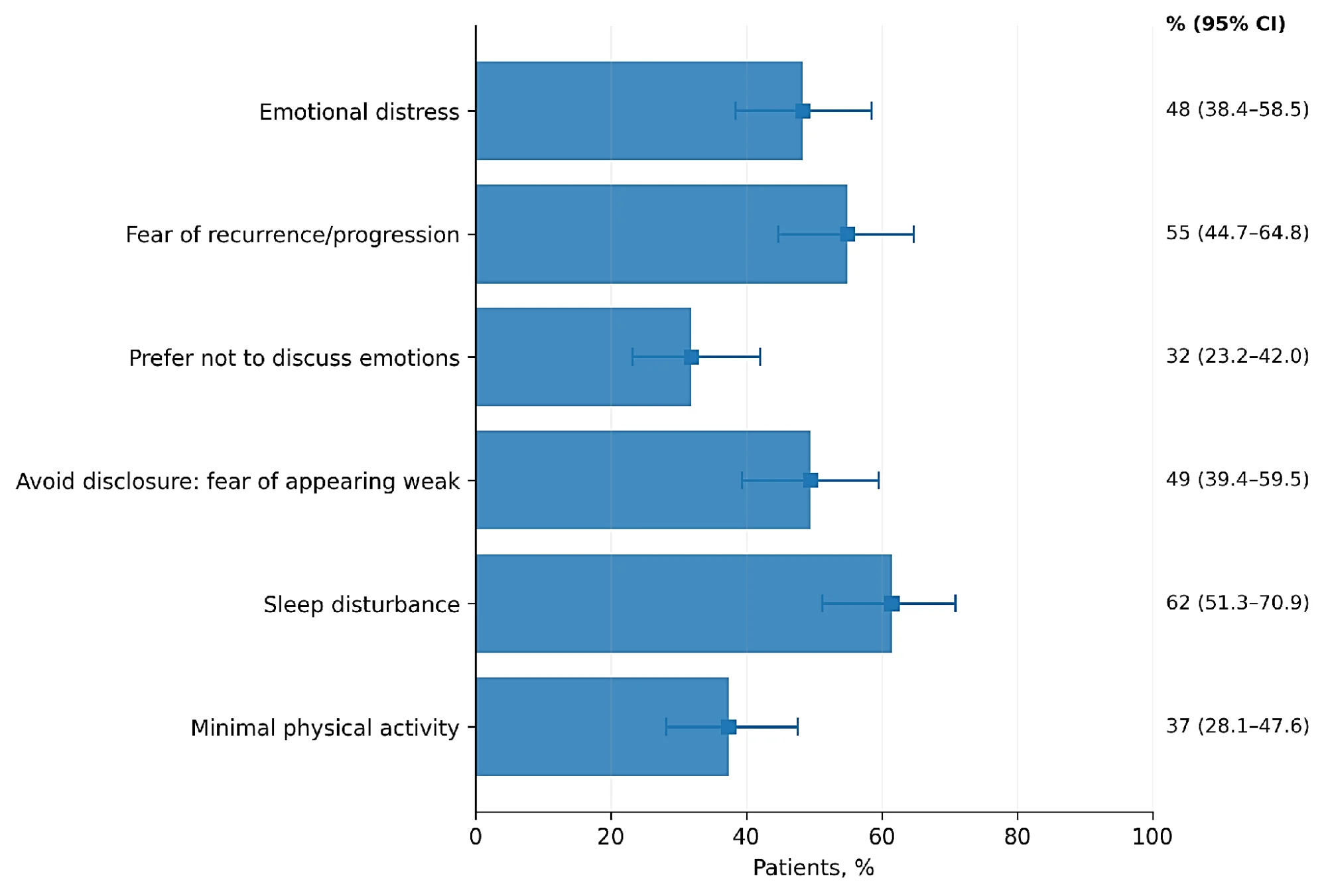
Figure 1․ Proportion of patients reporting selected psychosocial and lifestyle features. Bars show proportions among all respondents (N = 91); error bars show Wilson score 95% confidence intervals. Emotional distress combines the Q1 responses “overwhelmed” and “racing worries” (44/91). Fear of recurrence/progression combines the Q3 responses “greatest fear” and “worry a few times a month” (50/91). Prefer not to discuss emotions is the corresponding Q5 response (29/91). Avoid disclosure because of fear of appearing weak is the corresponding Q6 response (45/91). Sleep disturbance combines the three Q7 responses indicating sleeping less, sleeping more, or difficulty falling/staying asleep (56/91). Minimal physical activity is the Q8 response “little or none” (34/91). CI, confidence interval.
Discussion
This cross-sectional analysis describes a broad psychosocial burden among a self-selected online cohort of patients with RCC. The strongest descriptive signals were frequent recurrence/progression concerns, sleep disturbance, emotional/cognitive distress, and barriers to emotional disclosure. These findings should be interpreted as response patterns to individual survey items rather than prevalence estimates of anxiety, depression, insomnia, or other clinical constructs.
The results are directionally consistent with larger kidney cancer surveys. In the 2018 IKCC Global Patient Survey, psychosocial impacts were common, yet only about half of respondents disclosed such concerns to their healthcare team; the pattern differed by disease stage and country4. More recently, the 2025 IKCC Global Patient Survey reported emotional impact in 85% of respondents across disease stages, with disease-related anxiety and fear of recurrence among the most frequently reported concerns, while discussion with healthcare professionals remained incomplete5. An international 2025 survey of patients with advanced RCC also identified substantial wellbeing concerns and supportive-care priorities3. These studies used different instruments and populations, so the numerical estimates are not directly comparable with the present single-item responses.
Communication deserves particular attention. In separate items, 32% preferred not to discuss emotions and 49% avoided disclosure because they did not want to appear weak or be pitied. These proportions cannot be added or treated as mutually exclusive because individual-level overlap was unavailable. Nevertheless, both items point to a potential barrier to patient-initiated disclosure. This supports a practical role for routine, clinician-initiated psychosocial screening and explicit opportunities to discuss emotional concerns rather than waiting for patients to volunteer them4,5,7. In routine practice, this could include brief standardized distress screening, such as a distress thermometer, combined with structured clinician- or nurse-initiated opportunities to discuss emotional concerns and facilitate referral when appropriate.
The disease-status heterogeneity is clinically important. The survey used the wording “fear of recurrence,” but nearly half of respondents reported metastatic disease, for whom fear of progression is the more appropriate construct. The pooled response therefore represents a broad cancer-related recurrence/progression concern rather than a validated measure of fear of recurrence. Similarly, psychosocial exposure may differ substantially between patients under surveillance, those treated for localized disease, and those living with metastatic disease. Individual-level cross-tabulations by disease status were not available for this secondary analysis, precluding meaningful stratified estimates.
Sleep and physical activity findings also warrant cautious interpretation. Sixty-two percent selected a sleep-change response, but the item was not a validated sleep instrument and included heterogeneous patterns of reduced sleep, increased sleep, and difficulty initiating or maintaining sleep. Thirty-seven percent reported little or no physical activity, but exercise intensity was not captured. Contemporary RCC studies using validated patient-reported outcome measures demonstrate that health-related quality of life varies by disease setting and treatment, reinforcing the value of standardized longitudinal assessment in future work8. As cancer care becomes increasingly individualized and multidisciplinary, including the use of locally directed treatment for selected patients with oligoprogressive disease, the growing complexity and duration of cancer management may further reinforce the importance of addressing patients psychosocial needs throughout the disease trajectory9.
Several limitations constrain generalizability. The sample was small, cross-sectional, and self-selected, and online recruitment during a patient-awareness campaign may have preferentially reached individuals with internet access and greater engagement with patient advocacy activities. The cohort also included patients with localized, surveillance, and metastatic disease. The female majority (57%) is atypical for RCC, which generally has a male predominance, and may reflect differential participation in an online psychosocial survey. The PPWR was designed for awareness and conversation support, not psychometric measurement; each domain was represented by a single forced-choice item, and no validation against instruments such as the EORTC QLQ-C30, FKSI-19, Fear of Cancer Recurrence Inventory, or validated sleep measures was available. RCC diagnosis and disease status were self-reported. In addition, no formal ethics committee approval or waiver and no written informed consent were documented for the original anonymous patient-awareness initiative, which represents a governance limitation of this secondary analysis.
Survey access and initiation denominators, duplicate-prevention procedures, and exact field dates were not retained in the analytic dataset, preventing calculation of a response rate. Finally, aggregate country-level data did not permit assessment of overlap between responses or stratification by disease status, sex, treatment, or time since diagnosis.
Despite these limitations, the findings identify practical domains that can be addressed in routine RCC care: emotional concerns, recurrence/progression worry, willingness to disclose distress, sleep, physical activity, and relationship changes. Future studies should use validated instruments, collect longitudinal data, and prespecify analyses by disease stage and sex to distinguish transient concerns from persistent clinically relevant distress and to evaluate whether systematic screening improves referral and supportive-care uptake.
Conclusions
Patients with RCC who participated in this online survey frequently reported emotional concerns, recurrence/progression worry, communication barriers, sleep changes, and low physical activity. Because the instrument was nonvalidated and the cohort was self-selected and clinically heterogeneous, the findings are descriptive rather than diagnostic. They nevertheless support incorporating structured opportunities to identify and discuss psychosocial concerns within patient-centered RCC care.
Additional Information
Funding
This research received no external funding.
Conflict of interest
The authors declare that they have no competing interests.
Data availability statement
Aggregate data supporting the reported results are presented in Table 1. Individual respondent-level data were not available to the investigators for this secondary analysis.
Institutional review board statement
The original PPWR was an anonymous patient-awareness and conversation-support initiative. No institutional ethics committee approval or formal waiver was documented in the source materials available for this secondary analysis. The present analysis used anonymized, non-identifiable data only.
Informed consent statement
Participation in the online questionnaire was voluntary. Written informed consent was not collected; completion of the anonymous questionnaire constituted implied consent to participation in the campaign.
License
© Author(s) 2026.
This is an open-access article distributed under the terms of the Creative Commons Attribution 4.0 International License (CC BY 4.0), which permits unrestricted use, distribution, and reproduction in any medium, and unrestricted adaptation and reuse, including for commercial purposes, provided you give appropriate credit to the original author(s) and the source, provide a link to the Creative Commons license, and indicate if changes were made.
To view a copy of this license, visit https://creativecommons.org/licenses/by/4.0/.
References
-
Rose TL, Kim WY. Renal cell carcinoma: a review. JAMA. 2024;332(12):1001-10. doi:10.1001/jama.2024.12848.
-
Tsimafeyeu I, Shatkovskaya O, Krasny S, et al. Overall survival in patients with metastatic renal cell carcinoma in Russia, Kazakhstan, and Belarus: a report from the RENSUR3 registry. Cancer Rep (Hoboken). 2021;4(3):e1331. doi:10.1002/cnr2.1331.
-
Kotronoulas G, de la Serna CDLR, Drury A, et al. Wellbeing status and priority concerns of patients with advanced renal cell carcinoma: results of the EONS PROMs project international online survey. Support Care Cancer. 2025;33(6):531. doi:10.1007/s00520-025-09585-5.
-
Giles R, Maskens D, Bick R, et al. Patient-reported experience of diagnosis, management, and burden of renal cell carcinomas: results from a global patient survey in 43 countries. Eur Urol Open Sci. 2022;37:3-6. doi:10.1016/j.euros.2021.12.003.
-
Jonasch E, Bex A, Dabestani S, et al. Emotional health concerns due to kidney cancer (KC) and unmet needs in patient support: results from the International Kidney Cancer Coalition (IKCC) Global Patient Survey (GPS) [abstract]. J Clin Oncol. 2026;44(suppl):4532.
-
International Kidney Cancer Coalition. World Kidney Cancer Day 2021 [Internet]. International Kidney Cancer Coalition; 2021 [accessed 2026 Aug 11].
-
Vartolomei L, Schmidinger M, Vartolomei MD, et al. Psychological distress in patients treated for renal cell carcinoma: a systematic literature review. J Clin Med. 2022;11(21):6383. doi:10.3390/jcm11216383.
-
Duijn M, Yildirim H, van den Hurk C, et al. Health-related quality of life in localized and metastatic renal cell carcinoma: insights from patient-reported outcome measures. Eur Urol Open Sci. 2026;84:50-57. doi:10.1016/j.euros.2025.12.017.
-
Kaidarova D, Omarova I, Kaldarbekov S, et al. Consensus statements on the definition, diagnosis, and management of oligoprogressive disease: results of an expert survey of Kazakhstan Cancer Society. Explor Target Antitumor Ther. 2026;7:1002392. doi:10.37349/etat.2026.1002392.
How to Cite
Tsimafeyeu I, Davydova D, Bal V. Psychosocial burden and lifestyle impact in patients with renal cell carcinoma: a patient-reported outcomes analysis. OncoDaily Med J. 2026;3(2):e016. doi:10.69690/ODMJ-001-1026-8269