


Limited Prognostic Value of Baseline Curie Score in Children with High-Risk Neuroblastoma Treated with Contemporary Multi-modal Therapy: A Single-Center Retrospective Cohort Study


Abstract
Introduction: The Curie scoring system is a validated semi-quantitative method for assessing metastatic burden on 123I-metaiodobenzylguanidine (MIBG) scintigraphy in neuroblastoma. While post-induction Curie score has consistently demonstrated prognostic value, the clinical significance of baseline Curie score at diagnosis remains uncertain, particularly in the contemporary era of multi-modal therapy incorporating autologous hematopoietic stem cell transplantation (auto-HSCT) and anti-GD2 immunotherapy. This study evaluated the association between baseline Curie score and treatment outcomes in children with high-risk neuroblastoma treated at a tertiary referral center in the Kingdom of Saudi Arabia.
Methodology: We performed a retrospective cohort study of children diagnosed with high-risk neuroblastoma between January 2010 and December 2023. Baseline MIBG imaging suitable for retrospective Curie scoring was available in 21 patients. Patients were categorized using the previously validated Curie-score threshold of ≤2 versus >2 Associations with autologous hematopoietic stem-cell transplantation (auto-HSCT), radiation therapy, dinutuximab exposure, relapse, mortality, and survival were evaluated using exact or nonparametric methods as appropriate.Event-free survival (EFS) and overall survival (OS) were estimated by Kaplan-Meier analysis.
Results: Among the 41 patient overall cohort, 34 (82.9%) underwent auto-HSCT, 17 (41.5%) received radiation therapy, and 19 (46.3%) received dinutuximab. Baseline MIBG imaging was evaluable in 21 patients (51.2%); the median baseline Curie score was 9 (range, 0-30). Nine patients (42.9%) had a Curie score ≤2 and 12 (57.1%) had a score >2. Compared with patients with Curie scores ≤2, those with scores >2 had a numerically higher relapse frequency (50.0% vs 22.2%; odds ratio [OR], 3.50; 95% confidence interval [CI], 0.50-24.27; P=0.37), but the difference was not statistically significant. Mortality was 33.3% versus 55.6%, respectively (OR, 0.40; 95% CI, 0.07-2.37; P=0.39). No statistically significant association was observed between baseline Curie-score group and auto-HSCT, radiation therapy, or dinutuximab exposure. Kaplan–Meier analysis showed no statistically significant difference in EFS between Curie-score groups (median EFS, 35 vs 33 months; log-rank P=0.803).
Conclusion: In this small retrospective cohort, no statistically significant association between baseline Curie score and clinical outcomes was demonstrated. The numerical difference in relapse frequency and the wide confidence intervals emphasize the limited precision and statistical power
of the analysis. Baseline Curie score should therefore not be interpreted as definitively lacking prognostic value on the basis of this cohort alone. Larger prospective studies incorporating serial functional imaging and other response biomarkers are warranted.Baseline Curie score at diagnosis demonstrated limited prognostic utility in this contemporary cohort of children with high-risk neuroblastoma treated with multi-modal therapy. These findings support the evolving concept that dynamic response assessment following induction therapy provides greater prognostic information than baseline metastatic burden alone. Larger multi-center studies are warranted to define the role of diagnostic functional imaging within modern risk-adapted treatment strategies.
Keywords: Neuroblastoma; Curie score; 123I-MIBG; autologous stem cell transplantation; dinutuximab; pediatric oncology; prognosis; high-risk neuroblastoma.
Introduction
Neuroblastoma is the most common extracranial solid malignancy of childhood and accounts for approximately 15% of pediatric cancer-related mortality despite representing less than 10% of childhood malignancies. Survival has improved substantially during the past two decades through advances in multi-modal therapy, including intensive induction chemotherapy, surgical resection, radiotherapy, high-dose chemotherapy with autologous hematopoietic stem cell transplantation (auto-HSCT), differentiation therapy with isotretinoin, and anti-GD2 immunotherapy. Nevertheless, outcomes for children with high-risk disease remain unsatisfactory, with relapse continuing to represent the principal cause of treatment failure 1,2,3,4,5,6,7.
Accurate assessment of metastatic disease burden is central to risk stratification and treatment response evaluation in neuroblastoma. Approximately 90% of neuroblastomas demonstrate avid uptake of iodine-123 metaiodobenzylguanidine (123I-MIBG), making functional imaging an essential component of contemporary disease staging. The Curie scoring system provides a standardized semiquantitative assessment of metastatic burden by assigning scores to nine skeletal regions and one soft tissue compartment, generating a maximum score of 30. Since its introduction, the Curie score has become one of the most widely accepted imaging biomarkers in pediatric neuroblastoma 8,9,10,11,12,13.
Evidence from the Children’s Oncology Group (COG) and the International Society of Paediatric Oncology European Neuroblastoma Group (SIOPEN) has consistently demonstrated that post-induction Curie score is a robust predictor of survival. In contrast, the prognostic significance of baseline Curie score obtained at diagnosis remains controversial. Earlier studies suggested that diagnostic metastatic burden alone may not adequately reflect tumor biology or treatment responsiveness, particularly when intensive consolidation strategies are employed 8,9,14,15.
The therapeutic landscape of high-risk neuroblastoma has evolved considerably with the incorporation of anti-GD2 monoclonal antibody therapy and optimization of transplant-based consolidation. These advances may reduce the prognostic influence of baseline disease burden by modifying relapse risk and improving disease control among patients with initially extensive metastatic involvement. Consequently, the clinical utility of diagnostic Curie score requires reassessment within contemporary treatment paradigms 2,4,5,6,7,16,17.
Data evaluating baseline Curie score in Middle Eastern populations remain scarce. Regional studies are particularly important because differences in referral pathways, treatment implementation, access to immunotherapy, and supportive care may influence outcomes and external validity of existing prognostic models. Against this background, we evaluated the association between baseline Curie score at diagnosis and treatment characteristics and clinical outcomes in a real-world cohort of children with high-risk neuroblastoma treated at a tertiary referral center in Saudi Arabia. Because baseline MIBG imaging was not retrievable for all patients, the prognostic Curie-score analysis was restricted to the evaluable subset. We therefore considered the analysis exploratory and hypothesis-generating.
Methodology
Study Design and Setting
This retrospective, single-center cohort study was conducted at King Fahad Medical City, Riyadh, Saudi Arabia, a tertiary referral center for pediatric oncology and hematopoietic stem cell transplantation. Consecutive pediatric patients diagnosed with high-risk neuroblastoma between January 2010 and December 2023 were identified through institutional oncology databases and electronic medical records.
The study was approved by the Institutional Review Board of King Fahad Medical City. Owing to the retrospective nature of the study, informed consent was waived in accordance with institutional policies and the Declaration of Helsinki.
Study Population
Patients were eligible if they fulfilled all of the following criteria: age younger than 18 years at diagnosis, histologically confirmed neuroblastoma or ganglioneuroblastoma, classification as high-risk disease according to the International Neuroblastoma Risk Group (INRG) criteria applicable at the time of treatment and the availability of complete treatment and follow-up records.
Patients with relapsed disease at initial presentation, low- or intermediate-risk neuroblastoma, or insufficient clinical data were excluded.
Institutional case volume
During 2010-2023, the center diagnosed 77-194 new pediatric oncology patients annually. The annual number of newly diagnosed neuroblastoma cases, including all risk groups, ranged from 3 to 16. This relatively low annual neuroblastoma volume provides context for the extended retrospective accrual period required to assemble a cohort of high-risk patients.
Data Collection
Clinical information was extracted from electronic medical records using a standardized data collection form. Variables included demographic characteristics (age at diagnosis, sex); disease characteristics (primary tumor site, histopathology, differentiation, MYCN amplification, and extent of disease); treatment variables (surgical resection, radiotherapy, auto-HSCT, isotretinoin maintenance and dinutuximab immunotherapy); outcome variables (relapse, mortality, EFS, OS and duration of follow-up).
Curie Score Assessment
Baseline diagnostic 123I-MIBG scans were retrospectively reviewed when archived imaging was available. The Curie scoring system divides the body into nine skeletal regions and one soft-tissue region; each region is scored from 0 to 3 according to the extent of disease involvement, yielding a maximum score of 30. Patients were categorized using the previously validated threshold of ≤2 versus >2 for the primary analysis. Baseline MIBG imaging was available for 21 of the 41 eligible patients. The remaining 20 patients were retained in the overall cohort analyses but were not included in Curie-score-specific analyses. Follow-up MIBG examinations were performed in routine clinical care when available; because the timing and completeness of these examinations were not uniform across patients, serial Curie scores were not used as formal inferential endpoints in the present study.
Treatment
Patients received multi-modal therapy according to institutional protocols based on international high-risk neuroblastoma treatment strategies including induction chemotherapy, surgical resection, radiation therapy, autologous hematopoietic stem-cell transplantation, isotretinoin maintenance, and dinutuximab immunotherapy when available. Treatment approaches evolved during the study period.
Treatment decisions reflected protocol availability during the study period and individual patient characteristics.
Outcome Measures
The primary outcome was event-free survival (EFS), defined as time from diagnosis to relapse, progression, secondary malignancy, or death. Secondary outcomes included overall survival (OS), relapse, mortality, and associations between baseline Curie-score group and major treatment modalities.
Statistical Analysis
Continuous variables were summarized as median and interquartile range (IQR) or mean with standard deviation where appropriate. Categorical variables were reported as frequencies and percentages. Comparisons between Curie score groups were performed using Fisher’s exact test or χ² test for categorical variables, and Mann–Whitney U test for continuous variables with non-normal distributions. Effect estimates with 95% confidence intervals (CI) were calculated for key binary outcomes.
Event-free survival and overall survival were estimated using the Kaplan–Meier method and compared using the log-rank test.
Because only 21 patients had evaluable baseline Curie scores, multivariable survival model-ling was considered exploratory. Consequently, emphasis was placed on descriptive effect estimates and confidence intervals to avoid overfitting and unstable regression coefficients.
All statistical analyses were performed using IBM SPSS Statistics version 22 (IBM Corp., Armonk, NY, USA). A two-sided P value <0.05 was considered statistically significant. Because only 21 patients had evaluable baseline MIBG imaging and the number of outcome events was limited, multivariable regression was not performed. A multivariable model would have been vulnerable to overfitting and unstable estimates. The analysis was therefore intentionally con-servative and exploratory.
Results
Patient Characteristics
A total of 41 children fulfilled the study inclusion criteria during the study period.
The median age at diagnosis was 37 months (IQR 24-53.5 months), and males comprised 63.4% of the cohort. MYCN amplification was identified in 20 patients (48.8%), whereas 30 patients (73.2%) demonstrated unfavorable histology. Gross total resection was achieved in 25 patients (61.0%),
while 34 patients (82.9%) subsequently underwent autologous hematopoietic stem cell transplantation. Radiotherapy formed part of consolidation therapy in 17 patients (41.5%), whereas 19 patients (46.3%) received dinutuximab immunotherapy following its introduction into institutional practice. After a median follow-up of 7 years, relapse occurred in 13 patients (31.7%), and 19 patients (46.3%) died during follow-up.
Overall baseline characteristics are summarized in Table 1.
Table 1. Baseline demographic and clinical characteristics of study group
| Characteristic | Value |
|---|---|
| Age at diagnosis, median (IQR), months | 37 (24-53.5) |
| Male sex, n (%) | 26 (63.4) |
| Female sex, n (%) | 15 (36.6) |
| Favorable histology, n (%) | 9 (22.0) |
| Unfavorable histology, n (%) | 30 (73.2) |
| Histology not done, n (%) | 2 (4.9) |
| MYCN amplified, n (%) | 20 (48.8) |
| MYCN not amplified, n (%) | 16 (39.0) |
| MYCN not done, n (%) | 5 (12.2) |
| Gross total resection, n (%) | 25 (61.0) |
| Partial resection, n (%) | 2 (4.9) |
| Not resectable, n (%) | 14 (34.1) |
| Autologous HSCT, n (%) | 34 (82.9) |
| Radiation therapy, n (%) | 17 (41.5) |
| Dinutuximab, n (%) | 19 (46.3) |
| Relapse, n (%) | 13 (31.7) |
| Death, n (%) | 19 (46.3) |
| Follow-up, median (IQR), years | 7 (4-13) |
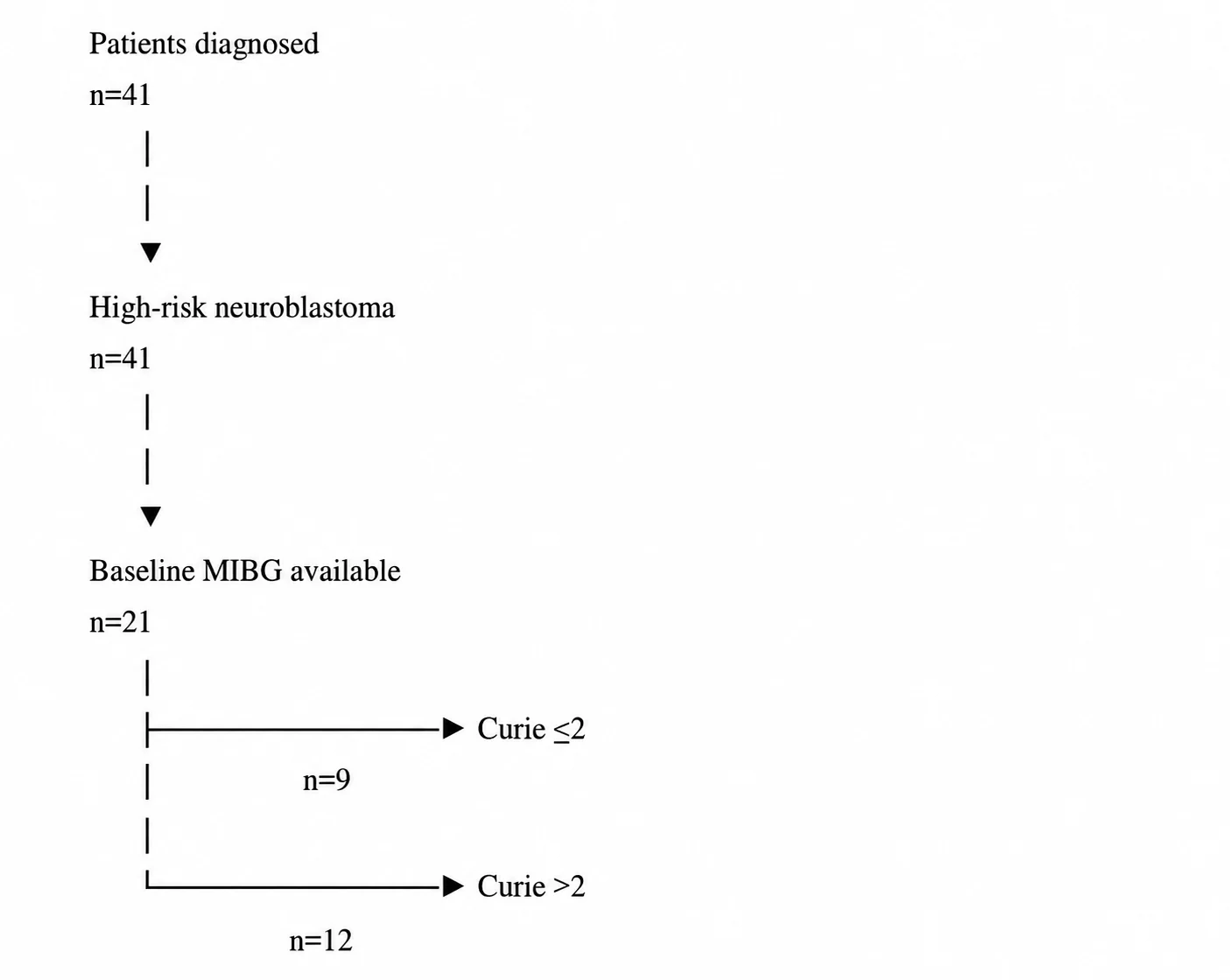
Figure 1: STROBE flow diagram
Baseline Curie Score
Baseline diagnostic MIBG imaging was available for 21 patients (51.2%). The median base-line Curie score was 9 (range: 0–30). Using previously validated thresholds 9 patients (42.9%) had Curie scores ≤2 and 12 patients (57.1%) had Curie scores >2 (Table 2).
Table 2. Baseline Curie-score distribution in the MIBG-evaluable cohort (n=21,51.2% of overall cohort)
| Variable | Studied Groups |
|---|---|
| Curie score at diagnosis | |
| Median (IQR) | 23.5 (7.25-27.25) |
| ≤2 | 9 (22%) |
| >2 | 12 (29.3%) |
| Curie scores mid treatment | |
| Median (IQR) | 1 (0.75-2) |
| ≤2 | 17 (41.5%) |
| >2 | 6 (14.6%) |
| Curie scores post-transplant | |
| Median (IQR) | 1 (0-3) |
| ≤2 | 5 (12.2%) |
| >2 | 1 (2.4%) |
Twenty patients were excluded from Curie-specific analyses because baseline MIBG scans were unavailable for retrospective review, but remained part of the overall cohort.
Association with Treatment Characteristics
Baseline Curie score demonstrated no statistically significant association with the receipt of major treatment modalities. Auto-HSCT was performed in 7 of 9 patients (77.8%) with Curie score ≤2 and 11 of 12 (91.7%) with score >2 (OR, 3.14; 95% CI, 0.24-41.51; P=0.55). Radiation therapy was administered to 6 of 9 (66.7%) and 10 of 12 (83.3%), respectively (OR, 2.50; 95% CI, 0.32-19.53; P=0.61). Dinutuximab was administered to 7 of 9 (77.8%) and 11 of 12 (91.7%), respectively (OR, 3.14; 95% CI, 0.24-41.51; P=0.55). The wide confidence intervals reflect the small sample size.
These findings suggest that baseline metastatic burden did not substantially influence delivery of multi-modal consolidation therapy within our cohort.
Association with Clinical Outcomes
Relapse occurred in 2 of 9 patients (22.2%) with Curie scores ≤2 and 6 of 12 (50.0%) with scores >2. The corresponding odds ratio was 3.50 (95% CI, 0.50-24.27; P=0.37). Thus, although the observed relapse frequency was more than twofold higher in the >2 group, the confidence interval was wide and included substantial uncertainty. Mortality occurred in 5 of 9 patients (55.6%) with Curie scores ≤2 and 4 of 12 (33.3%) with scores >2 (OR, 0.40; 95% CI, 0.07-2.37; P=0.39). No statistically significant association between baseline Curie-score category and mortality was demonstrated (Table 3).
Table 3. Associations between baseline Curie-score category and treatment/outcome variables
| Outcome | Curie ≤2 (n=9) | Curie >2 (n=12) | OR (95% CI) | P value |
|---|---|---|---|---|
| Relapse, n (%) | 2 (22.2%) | 6 (50.0%) | 3.50 (0.50-24.27) | 0.37 |
| Death, n (%) | 5 (55.6%) | 4 (33.3%) | 0.40 (0.07-2.37) | 0.39 |
| Autologous HSCT, n (%) | 7 (77.8%) | 11 (91.7%) | 3.14 (0.24-41.51) | 0.55 |
| Radiation therapy, n (%) | 6 (66.7%) | 10 (83.3%) | 2.50 (0.32-19.53) | 0.61 |
| Dinutuximab, n (%) | 7 (77.8%) | 11 (91.7%) | 3.14 (0.24-41.51) | 0.55 |
Although not statistically significant, the higher relapse frequency observed in patients with elevat-ed baseline Curie scores may suggest a clinically relevant trend that warrants validation in larger cohorts.
Survival Outcomes
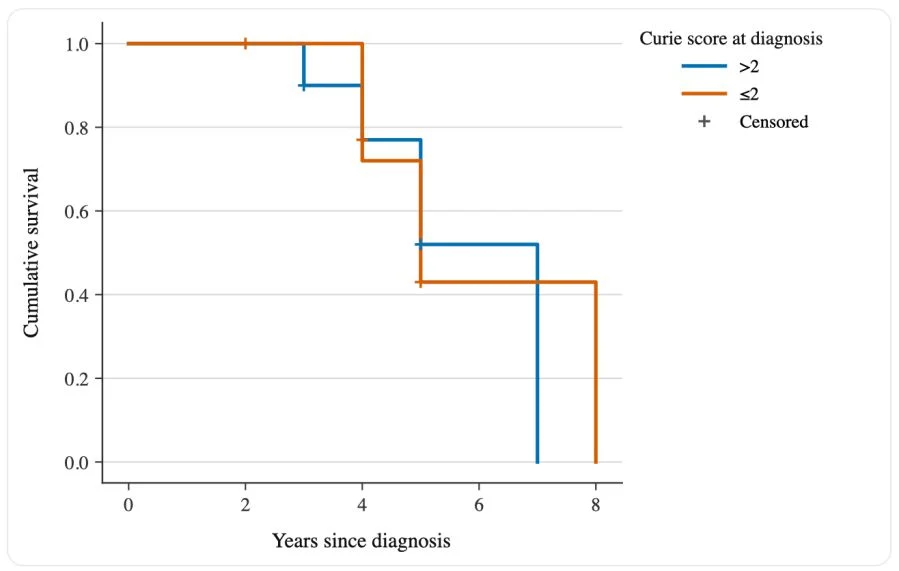
Kaplan-Meier analysis demonstrated no statistically significant difference in EFS according to baseline Curie score category. Median EFS was 35 months for patients with Curie scores ≤2 and 33 months for patients with Curie scores >2 (Log-rank p = 0.803). OS similarly did not differ significantly between groups. The absence of statistically significant survival differences should be interpreted cautiously in view of the limited sample size and incomplete availability of baseline MIBG imaging (Figure 2).
Figure 2: Kaplan-Meier analysis
Discussion
In this retrospective cohort of children with high-risk Neuroblastoma treated in the era of multi-modal consolidation therapy, we evaluated whether baseline Curie score at diagnosis retained prognostic significance for survival outcomes. Our study demonstrated that although higher baseline Curie scores reflected greater metastatic burden at diagnosis, they were not significantly associated with mortality, relapse, transplant utilization, receipt of Dinutuximab immunotherapy, or EFS. Patients with baseline Curie scores >2 demonstrated a numerically higher relapse rate compared with patients with scores ≤2 (50% vs 22%); however, this did not reach statistical significance, likely due to limited sample size. Importantly, this should not be interpreted as evidence that baseline Curie score has no prognostic value. Only 21 of the 41 eligible patients had retrievable baseline MIBG imaging, and the resulting estimates were imprecise, as reflected by the wide confidence intervals. The observed relapse frequency was numerically higher among patients with Curie scores >2 (50.0% vs 22.2%), with an OR of 3.50, but the 95% CI was wide (0.50-24.27) and the association did not reach statistical significance.
Our findings are consistent with the landmark Children’s Oncology Group analysis by Gregory A. Yanik et al., who first demonstrated that diagnostic Curie score had limited prognostic significance compared with post-induction Curie score in patients with stage 4 neuroblastoma treated on protocol A3973. In that multi-center study involving 280 patients, baseline Curie score did not significantly predict EFS, whereas post-induction Curie score >2 was strongly associated with inferior outcomes. Patients with post-induction Curie scores >2 had significantly worse 3-year EFS compared with those with scores ≤2, highlighting that treatment response rather than initial metastatic burden may better reflect tumor biology and long-term prognosis 14.
This concept was further reinforced by Gregory A. Yanik and colleagues in their subsequent collaborative analysis between Children’s Oncology Group and SIOPEN, which validated post-induction Curie scoring across international cohorts. In the 2018, in the Journal of Nuclear Medicine validation study, post-induction Curie scores >2 remained independently associated with inferior survival outcomes across both North American and European populations, confirming reproducibility across treatment platforms. These findings collectively suggest that dynamic assessment of disease response is substantially more informative than static baseline imaging alone 8,9,10,11,13,17.
Our data are particularly relevant because the majority of our cohort underwent auto-HSCT (82.9%), and nearly half received Dinutuximab immunotherapy. This reflects a treatment paradigm that differs substantially from older neuroblastoma cohorts. It is important to note however, that our study was not designed to evaluate whether either treatment modifies the prognostic effect of Curie score, and the small sample precludes reliable interaction analyses. In the recent Children’s Oncology Group report by Kathryn A. Streby et al., investigators examined diagnostic and end-of-induction Curie scores in patients treated with tandem high-dose chemotherapy followed by auto-HSCT. While diagnostic Curie score again showed limited prognostic value, end-of-induction Curie score remained strongly predictive of outcomes even after tandem transplant consolidation15. This study is particularly important because it mirrors the therapeutic intensity used in many modern high-risk neuroblastoma protocols and supports our observation that baseline disease burden alone may not adequately stratify outcomes after aggressive consolidation therapy 9,10,14.
Increasingly, neuroblastoma prognostication is shifting toward response-adapted models that incorporate imaging, molecular profiling, and treatment responsiveness. Mark A. Applebaum and colleagues from the International Neuroblastoma Risk Group demonstrated that machine learning models incorporating early treatment response may outperform traditional baseline risk factors in predicting chemotherapy responsiveness in newly diagnosed high-risk neuroblastoma9. Their findings reinforce the growing recognition that biologic behavior evolves during treatment and may not be fully captured by baseline imaging metrics1,2,3,4,5,6,7,12,13,18.
Similarly, the emergence of anti-GD2-based immunotherapy may further alter the prognostic implications of baseline metastatic burden. Recent data evaluating Naxitamab demonstrated measurable reductions in Curie score among patients with relapsed or refractory disease, suggesting that immunotherapy may directly modify functional imaging response patterns 18. Although our study evaluated frontline rather than relapsed disease, these findings further emphasize that Curie score should increasingly be interpreted as a dynamic biomarker rather than a fixed diagnostic variable 2,7,16.
The study has several strengths. It represents a longitudinal real-world cohort from a tertiary pediatric oncology center in Saudi Arabia, with substantial exposure to contemporary multimodal treatment. The institutional case-volume data also demonstrate the relatively small annual number of neuroblastoma diagnoses, providing context for the extended accrual period. In addition, the manuscript explicitly distinguishes the 41-patient overall cohort from the 21-patient MIBG-evaluable cohort, reducing ambiguity in interpretation.
Limitations
Our study has several important limitations that should be considered when interpreting its findings. The most important limitation is the relatively small effective sample size for the primary prognostic analysis, which reduces statistical power and increases the probability of a type II error. In addition, the retrospective nature of the study introduces the possibility of selection and
information bias. Also, the study covers a relatively long period, from 2010 through 2023, during which the management of high-risk neuroblastoma evolved considerably. Lastly, our study was performed at a single tertiary pediatric oncology center and the relatively small annual number of neuroblastoma diagnoses limits external validity.
Despite these limitations, our study offers several important strengths. It represents one of the few reports from the Middle East evaluating Curie score in children treated in the transplant and immunotherapy era and provides real-world outcome data from an underrepresented population. Furthermore, our cohort reflects contemporary therapeutic intensity including auto-HSCT, radiation therapy, isotretinoin, and anti-GD2 immunotherapy.
Future studies should move beyond baseline Curie score alone and focus on dynamic biomarkers such as post-induction Curie score, minimal residual disease assessment, circulating tumor DNA, radiomic analysis, and molecular response profiling. These approaches may better identify patients at highest risk of relapse and guide individualized consolidation strategies.
Conclusion
In this single center retrospective cohort of children with high-risk neuroblastoma treated with contemporary multi-modal therapy, baseline Curie score at diagnosis was not significantly associated with relapse, EFS, OS, or utilization of major treatment modalities, including auto-HSCT and anti-GD2 immunotherapy. Although patients with higher baseline Curie scores demonstrated a numerically greater risk of relapse, the estimate was imprecise and the study was underpowered to exclude a clinically meaningful association. Accordingly, our findings should be interpreted as exploratory rather than definitive…
Nonetheless, these findings reinforce the evolving paradigm that dynamic response assessment following induction therapy provides greater prognostic information than static baseline imaging and should remain central to future risk-adapted treatment strategies. Prospective multi-center studies incorporating standardized serial MIBG imaging, molecular biomarkers, measurable residual disease assessment, circulating tumor DNA, and radiomic analyses are warranted to refine prognostic models and further personalize therapy for children with high-risk neuroblastoma.
License
© Author (s), [2026].
This is an open access article distributed under the terms of the Creative Commons Attribution 4.0 International License (CC BY 4.0), which permits unrestricted use, distribution, and reproduction in any medium, and unrestricted adaptation and reuse, including for commercial purposes, provided you give appropriate credit to the original author(s) and the source, provide a link to the Creative Commons license, and indicate if changes were made.
To view a copy of this license, visit https://creativecommons.org/licenses/by/4.0/.
References
-
Matthay KK, Maris JM, Schleiermacher G, et al. Neuroblastoma. Nat Rev Dis Primers. 2016;2:16078.
-
Sharma R, Yadav J, Bhat SA, et al. Emerging trends in neuroblastoma diagnosis, therapeutics, and research. Mol Neurobiol. 2025;62(5):6423-6466.
-
Thakur A, Dijkstra A. Hallmarks of neuroblastoma—pathophysiology, diagnosis, and therapeutic interventions. Cancer Nexus. 2025;1(2).
-
Sainero-Alcolado L, Sjöberg Bexelius T, Santopolo G, et al. Defining neuroblastoma: from origin to precision medicine. Neuro Oncol. 2024;26(12):2174-2192.
-
Katta SS, Nagati V, Paturi ASV, et al. Neuroblastoma: emerging trends in pathogenesis, diagnosis, and therapeutic targets. J Control Release. 2023;357:444-459.
-
De Bona A, Barbieri M, Rinaldi N, Esposito S. Neuroblastoma in childhood: biological insights, risk stratification, and advances in multimodal therapy. J Clin Med. 2026;15(3):1101.
-
Wahba A, Wolters R, Foster JH. Neuroblastoma in the era of precision medicine: a clinical review. Cancers (Basel). 2023;15(19):4722.
-
Streby KA, Parisi MT, Shulkin BL, et al. Impact of diagnostic and end-of-induction Curie scores with tandem high-dose chemotherapy and autologous transplants for metastatic high-risk neuroblastoma: a report from the Children’s Oncology Group. Pediatr Blood Cancer. 2023;70(8).
-
Yanik GA, Parisi MT, Naranjo A, et al. Validation of postinduction Curie scores in high-risk neuroblastoma: a Children’s Oncology Group and SIOPEN Group report on SIOPEN/HR-NBL1. J Nucl Med. 2018;59(3):502-508.
-
Decarolis B, Schneider C, Hero B, et al. Iodine-123 metaiodobenzylguanidine scintigraphy scoring allows prediction of outcome in patients with stage 4 neuroblastoma: results of the Cologne interscore comparison study. J Clin Oncol. 2013;31(7):944-951.
-
Riaz S, Bashir H, Khan SJ, Qazi A. I-131 mIBG scintigraphy Curie versus SIOPEN scoring: prognostic value in stage 4 neuroblastoma. Mol Imaging Radionucl Ther. 2018;27(3):121-125.
-
Sharp SE, Shulkin BL, Gelfand MJ, Salisbury S, Furman WL. 123I-MIBG scintigraphy and 18F-FDG PET in neuroblastoma. J Nucl Med. 2009;50(8):1237-1243.
-
Littooij A, Olianti C, Brisse H, et al. Imaging of high-risk neuroblastoma: recommendations from SIOPEN Radiology and Nuclear Medicine Specialty Committees. Pediatr Blood Cancer. 2026;73(5).
-
Yanik GA, Parisi MT, Shulkin BL, et al. Semiquantitative mIBG scoring as a prognostic indicator in patients with stage 4 neuroblastoma: a report from the Children’s Oncology Group. J Nucl Med. 2013;54(4):541-548.
-
Mayampurath A, Ramesh S, Michael D, et al. Predicting response to chemotherapy in patients with newly diagnosed high-risk neuroblastoma: a report from the International Neuroblastoma Risk Group. JCO Clin Cancer Inform. 2021;5:1181-1188.
-
Yu AL, Gilman AL, Ozkaynak MF, et al. Anti-GD2 antibody with GM-CSF, interleukin-2, and isotretinoin for neuroblastoma. N Engl J Med. 2010;363(14):1324-1334.
-
Sánchez-Vañó R, Balaguer J, Borrego-Dorado I, et al. Recommendations for the use of nuclear medicine imaging in patients with neuroblastoma. Clin Transl Oncol. 2025;27(6):2401-2415.
-
Mora J, Chan GCF, Morgenstern DA, et al. Reduction in Curie score in neuroblastoma patients treated with naxitamab. J Clin Oncol. 2023;41(16 Suppl):10042.
How to Cite
Malaeb F, Bez IE, Rayis M, Ullah Z, Alhazzaa S, Abdelnaser A. Limited Prognostic Value of Baseline Curie Score in Children with High-Risk Neuroblastoma Treated with Contemporary Multi-modal Therapy: A Single-Center Retrospective Cohort Study. OncoDaily Med J. 2026;3(2):e015. doi:10.69690/ODMJ-001-1026-8309