


Development and Outcomes of Resource-Adapted Paediatric Oncology Guidelines in Africa


Abstract
Introduction: While survival rates for childhood cancer now exceed 80% in many high-income countries (HICs), outcomes across Africa remain poor, largely because of economic and health system limitations. The use of treatment regimens developed for resource-rich settings in resourceconstrained environments is linked in some places to lower survival rates. Three strategies have emerged to address the need for context-specific guidelines and protocols, namely: adapted treatment regimens (ATR), adapted treatment guidelines (ATG), and graduated treatment regimens (GTR). We evaluated the adoption of these program designs across the African continent and their impact on outcomes.
Methodology: A narrative review with systematic elements was conducted in accordance with SANRA guidelines. PubMed/MEDLINE, EMBASE, Cochrane Central Library, Web of Science, and the African Index Medicus module were searched from January 1990 to January 2026. Studies were included if they described the development, content or outcomes of adapted or graduated paediatric oncology treatment regimens in African LMIC settings.
Results: Nineteen protocols met inclusion criteria: ten adapted treatment guidelines produced through the SIOP-PODC collaborative framework of individual tumours of which two were clinically tested and nine additionally clinically tested regimens. These regimens involve haematological, solid and neuro-oncological tumours. In total five regimens were classified as GTR and fourteen as ATR. Clinically evaluated regimens were generally associated with improved survival compared with historical cohorts. African collaborative groups demonstrated an increase in end-of-treatment survival, overall survival and the first documented graduated intensification sequence in a rural lowincome African setting without paediatric oncologists. There was acceptable low treatment-related mortality, enabling ministry-approved protocol escalation. Improving health systems, bidirectional African education on clinical findings, social support to families and integration of supportive care and abandonment-reduction strategies augment the improved outcomes of adapted regimens.
Conclusion: Collectively, the evidence indicates that context-adapted approaches offer the most sustainable pathway to improve childhood cancer outcomes in Africa. Adapted regimens improve patient level outcomes, adapted guidelines strengthen governance and standardisation of care, and graduated protocols provide a mechanism for evidence generation and progressive capacity building for translation into protocol frameworks and government policies.
Keywords: Adapted guidelines, graduated protocols, childhood cancer, outcomes, Africa
Introduction
Global resource disparities in childhood cancer are an under addressed global health burden with survival rates across Africa below 30%, falling behind high income settings1. These disparities are driven by delayed treatment referral, hospital system limitations including the direct application of guidelines designed for high-income countries (HIC) without contextual adaptation 2,3. Three complementary resource-adapted strategies have emerged to address the challenges: adapted treatment regimens (ATR), adapted treatment guidelines (ATG), and graduated treatment regimens (GTR). Despite these terms being used interchangeably, they represent conceptually and operationally distinct approaches, differing in their level of specificity, primary goals and developmental methodologies 4,5. The absence of clear definitions has impeded systematic comparisons of outcomes, complicated advocacy and obscured the different theories of change underlying each approach. An ATR refers to the systematic modification of a specific chemotherapy regimen’s medication, doses and intensity to account for the resource constraints and patient characteristics of a defined setting 5. The primary goal is clinical: to maximise the probability of cure while reducing toxicity and resource demands for the individual patient. Development is empirical, grounded in retrospective and prospective institutional outcome data, toxicity surveillance and pharmacological rationale 6,7. The first adapted African protocol for children emerged in the 1990s through a collaboration of the International Society for Paediatric Oncology (SIOP) Africa with financial assistance from SIOP and the World Health Organization (WHO)8. The study documented the improved survival with less intense and less costly medicines. Separately the Groupe Franco-Africain d’Oncologie Pédiatrique (GFAOP)-led modifications of protocols for BL, acute lymphoblastic leukaemia (ALL) and Wilms tumour (WT) across French-speaking Africa, improved survival compared with unadapted HIC protocols 9,10. An ATG, rather than specify a single protocol, provides a framework of clinical recommendations covering management elements of diagnosis, treatment selection, response assessment and supportive care that are tailored to the resource realities and health system characteristics of a country or region 5,11. Their primary goal is systemic: to standardise practice, establish accountability, facilitate training and support national programme implementation. Development involves formal multi-stakeholder processes and structured evidence review 5,7. In contrast to ATR, ATG function principally as governance instruments and are applicable across institutions and disease types. Graduated treatment protocols are prospectively tiered frameworks, designed from inception to offer multiple levels of treatment intensity calibrated to different resource capacities 5,12. Each tier defines a minimum evidence-informed standard for a specific resource context 4. Patients or institutions may be assigned to the appropriate tier based on available infrastructure and resources. This design has a dual purpose: ensuring that every child receives the most intensive treatment their setting permits, while generating prospective comparative data across tiers to understand the relationship between resource level and outcome with the aim of building management capacity 13,14. Beyond terminology, it is important to emphasize that the development of these approaches is not simply about competing strategies for reducing the intensity of treatment, but rather a comprehensive philosophy of care. These three approaches have evolved in Africa through overlapping trajectories shaped by the growth of collaborative networks including GFAOP, International Society for Paediatric Oncology in Developing Countries (SIOP–PODC) and African paediatric oncology groups, who accumulated evidence of poor outcomes from using unadapted guidelines. The ideal programmes integrate all three strategies: adapted regimens provide clinical guidelines, ATGs provide governance infrastructure, and GTR provide the evidence-generating framework for iterative improvement of both human and material resources 13,14. This review examines the evolution of ATRs, ATGs and GTRs within African paediatric oncology, evaluates the available evidence supporting their implementation and clinical outcomes, and identifies priorities for future research, programme development and policy.
Methodology
Study design
This review was conducted as a narrative review with systematic search methods in accordance with SANRA guidelines. The methodology was designed to systematically identify, select, and critically appraise the published literature describing the historical development, implementation and reported outcomes of adapted treatment regimens (ATR), adapted treatment guidelines (ATG) and graduated treatment regimens (GTR) for childhood cancer in Africa. Owing to the anticipated methodological heterogeneity of the available literature, a narrative synthesis was considered more appropriate than a formal systematic review or metaanalysis.
Search strategy and eligibility criteria
A pre-specified search strategy (Supplementary Table 1) was developed before literature screening. PubMed/MEDLINE, EMBASE, the Cochrane Central Library, Web of Science Core Collection and the African Index Medicus were searched for studies published between 1 January 1990 and 31 January 2026. Controlled vocabulary and free-text terms relating to paediatric oncology, childhood cancer, adapted treatment, graduated treatment, guidelines, protocols and Africa were combined. Additional sources included Pediatric Blood and Cancer congress abstracts, SIOP and GFAOP websites, ClinicalTrials.gov, the Pan African Clinical Trials Registry and reference lists of eligible studies. Two reviewers screened titles, abstracts and full texts. Verification was done by twelve African authors, who developed guidelines, were asked to independently perform screening and suggest additional sources. Disagreements were resolved by discussion and consensus. Data extraction was performed using a standardised data collection form capturing study characteristics, tumour type, intervention, implementation strategy and reported outcomes. As this was a narrative review with systematic search methods, a protocol was not prospectively registered. Eligible publications included studies of children and adolescents (<19 years) with cancer managed in African LMICs that described the development, implementation or evaluation of ATRs, ATGs or GTRs. Primary research, implementation studies, consensus guidelines and review articles were eligible irrespective of publication language. Case reports involving fewer than five patients, editorials without original data and publications without an explicit African context were excluded (Figure 1).
Figure 1: Flow diagram of the study methodology
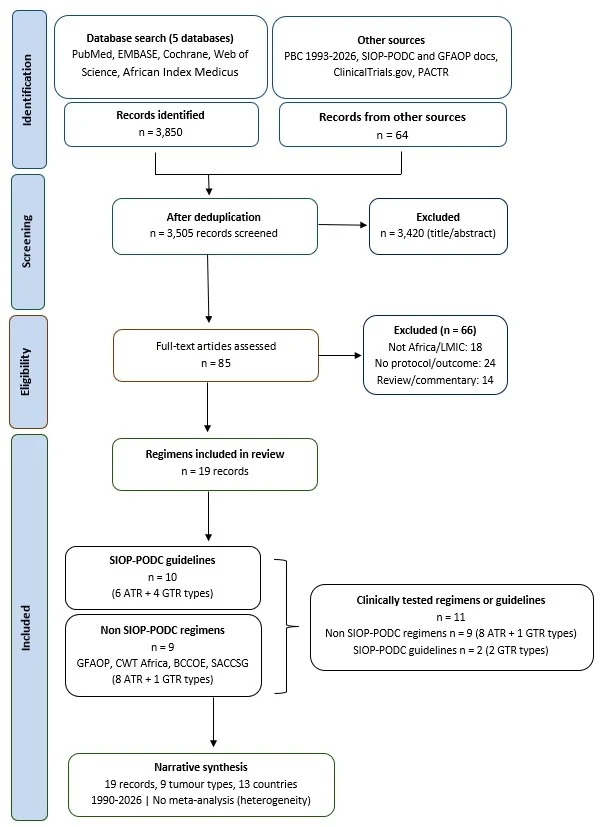
Abbreviations: PBC – Pediatric Blood and Cancer; SIOP-PODC – International Society for Paediatric Oncology of Developing Countries; PACTR – Pan African Clinical Trials Registry; LMIC – low- and middle-income country(ies); ATR – adapted treatment regimens; GTR – Graduated treatment regimens; GFAOP – Groupe Franco-Africain d’Oncologie Pédiatrique; CWT – collaborative Wilms Tumour; BCCOE – Butaro Cancer Center of Excellence; SACCSG, South African Children’s Cancer Study Group
Quality Appraisal and Synthesis
Methodological quality was assessed using instrument-appropriate appraisal tools. Consensus guideline publications were evaluated using the AGREE II framework adapted for LMIC guideline development (Supplementary Table 2). The AGREE II instrument contains 23 items organised into six domains: scope and purpose, stakeholder involvement, rigour of development, clarity of presentation, applicability and editorial independence. Each item was rated from 1 (strongly disagree) to 7 (strongly agree). Quality appraisal informed interpretation of the evidence rather than study exclusion, and a summary of the appraisal results were provided as supplementary material. Data were synthesised narratively using descriptive mapping according to tumour type, resource setting, geographic region, publication period and programme characteristics. Quantitative meta-analysis was not undertaken because of substantial heterogeneity in study design, interventions, outcome measures and reporting.
Results
Historical background of adapted paediatric oncology guidelines in Africa
Period before adapted guidelines (before 1990)
Prior to the 1990s, children diagnosed with cancer in sub-Saharan Africa (SSA) were either received palliative care or attenuated versions of HIC regimens designed for high-resourced settings (Supplementary Table 3). These regimens were associated with prohibitive costs, high treatment-related mortality (TRM) from inadequate supportive care and frequent treatment abandonment 3.
Early development of adapted regimens (1994 to 2000)
At the first African Continental Conference of the International Society of Paediatric Oncology (SIOP-Africa) in 1994, delegates from 23 African countries identified the need for treatment approaches adapted to the resource constraints of African healthcare settings. This meeting led to the initiation of the Malawi Pilot Study of Burkitt lymphoma treatment, which represents the earliest documented Africa-adapted paediatric oncology treatment protocol included in this review 8. The initial protocol, adapted from the French LMB89 regimen, was associated with a treatment-related mortality (TRM) of 32% during the pilot phase. A subsequent regimen consisting of oral cyclophosphamide and intrathecal methotrexate reported a one-year eventfree survival (EFS) of approximately 48–57%, with lower reported treatment-related toxicity than the initial regimen, although relapse remained frequent 15.
Francophone Africa and graduated-intensity protocols (2001 to present)
From 2001 onwards, the Groupe Franco-Africain d’Oncologie Pédiatrique (GFAOP) implemented a series of prospective treatment protocols for Burkitt lymphoma across Francophone Africa 10. Initial protocols used cyclophosphamide monotherapy, followed by sequential incorporation of vincristine, methotrexate and prednisone through successive GFALMB protocols. High-dose methotrexate (3 g/m²) was administered in centres with the required supportive care capacity, while centres with more limited resources used lowerintensity regimens 16. In the third prospective study, the reported one-year overall survival (OS) for advanced Burkitt lymphoma was 60%, with a TRM of 12% 16. These protocols were implemented across Cameroon, Madagascar, Senegal, Mali, Côte d’Ivoire, Burkina Faso and Togo through a series of prospective multicentre studies.
Development of SIOP-PODC resource-stratified guidelines (2009–2017)
In 2009, Treatment Strategies and Regimens of Graduated Intensity for Childhood Acute Lymphoblastic Leukaemia in Low-Income Countries introduced a graduated-intensity treatment framework for childhood ALL4. The publication described three treatment regimens of increasing intensity, adapted from successive CCG/COG protocols developed between the 1970s and 1990s, with each regimen requiring progressively greater supportive care capacity. The proposed implementation strategy recommended initiating treatment with Regimen 1 and progressing to higher-intensity regimens only after demonstrating safe implementation within the local healthcare setting 4.
Following the restructuring of the SIOP-PODC programme in 2011, the Adapted Treatment Guideline Working Group was established to develop resource-adapted clinical guidelines for common childhood cancers encountered in LMICs. Initial guideline development focused on the cancers subsequently recognised as the six index cancers of the Global Initiative for Childhood Cancer (GICC).
In 2017, the SIOP-PODC published a resource-stratified framework for guideline development in LMICs, defining three service levels: Setting 1 (minimal resources), Setting 2 (intermediate resources) and Setting 3 (near high-income country resources) 12. Between 2013 and 2020, disease-specific adapted treatment guidelines were published for nephroblastoma, Burkitt lymphoma, neuroblastoma (NBL), supportive care, medulloblastoma (MB), low-grade glioma (LGG), acute myeloid leukaemia (AML), craniopharyngioma and radiotherapy 12,17,18,19,20,21. In collaboration with SIOP-PODC, the Paediatric Radiation Oncology Society for Low- and Middle-Income Countries (PROS-LMIC) developed guidance for paediatric radiotherapy delivery in resource-limited settings. The recommendations addressed equipment procurement, maintenance planning, treatment protocols, three-dimensional planning and quality assurance, with separate recommendations provided for low-income and middle-income country settings where appropriate 22.
The SIOP-PODC retinoblastoma guideline was classified as a graduated treatment regimen (GTR) because it prospectively defined three resource-stratified treatment pathways according to available infrastructure and healthcare resources 17. Clinical implementation of this guideline was subsequently reported in a prospective study conducted in two Cameroonian mission hospitals 23. The medulloblastoma guideline presented chemotherapy and radiotherapy recommendations according to predefined service levels, while the craniopharyngioma guideline stratified recommendations according to the availability of neurosurgical and radiotherapy services 24.
The Collaborative Wilms Tumour Africa Project (2013 to present)
The Collaborative Wilms Tumour (CWT) Africa Project was initiated in 2013, with prospective multicentre implementation commencing in January 2014 (ClinicalTrials.gov identifier: NCT01991652). The programme was established across eight centres in Malawi, Ghana, Cameroon, Uganda and Ethiopia 25. The adapted treatment guideline incorporated SIOPPODC-based recommendations for Wilms tumour management, including preoperative chemotherapy, nutritional support and interventions to reduce treatment abandonment. During the initial implementation period, end-of-treatment survival increased from 52% to 68% (p=0.01), while treatment abandonment decreased from 23% to 13% (p=0.03) 25. Subsequent follow-up reported a two-year event-free survival (EFS) of 49.9% 26.
Between 2023 and 2026, the Collaborative African Network for Childhood Cancer Care and Research (CANCaRe Africa), coordinated from Blantyre, Malawi, expanded implementation of adapted treatment guidelines through prospective multicentre clinical studies involving ten hospitals across seven African countries 27,28,29. The network has reported clinical outcomes, updated protocol versions and related programme publications 27,28,29. A 2024 analysis of the CWT Africa programme reported treatment abandonment exceeding 20% across participating countries despite improvements in survival outcomes 27,28,29. The CWT Africa programme represents one of the largest prospective evaluations of adapted treatment guideline implementation for childhood cancer reported from sub-Saharan Africa.
The PODC AML and brain tumour guidelines (2017 to 2023)
The SIOP-PODC Adapted AML Guideline was the first adapted AML protocol for LMICs 20. It introduced a ‘prephase’ concept of low-dose etoposide, with or without thioguanine and prednisone, or IV etoposide to stabilise patients prior to induction, combined with a high-dose cytarabine consolidation 20. An implementation study at Moi Teaching and Referral Hospital, Kenya compared outcomes before and after SIOP-PODC AML guideline adoption with important findings 30.
The SIOP-PODC guidelines for neuro-oncological tumours, LGG, craniopharyngioma, and medulloblastoma, were developed with a prominent contribution from the University of Cape Town. The MB guideline proposes radiotherapy and chemotherapy approached based on setting defined by the service line levels cited ion the framework paper. The LGG guideline stratifies management by available neurosurgical, imaging, and chemotherapy resources. Reports on the implementation and feasibility of the neuro-oncology guidelines are yet to be published.
The ARIA Guide collaboration (2020 to present) and individual country efforts
The Comprehensive Management Guidelines for Childhood Cancer for the development of a global platform for resource adapted childhood cancer treatment and care, including The Adapted Resource and Implementation Application (ARIA) Guide collaboration between St. Jude Global and partners SIOP, PROS, IPSO and CCI began in early 2020. The collaboration developed from a shared goal to close the global child cancer survival gap by providing evidence-based guidance for the management of cancer in children, independent of setting 31,32. Although SIOP-PODC previously developed and published a series of “resourceadapted treatment regimens” for use in resource-limited settings, these publications did not include the practical guidance or implementation tools needed to support day-to-day care. The ARIA Guide develops practical and comprehensive childhood cancer management guidelines hosted on a web portal and include a number of African collaborators and advisors, is yet to be implemented and tested for feasibility 31,32.
National and regional guideline efforts (2015 to present)
The South African Association of Paediatric Haematology Oncology (SAAPHO; formerly the South African Children’s Cancer Study Group [SACCSG]) has coordinated the development and implementation of nationally harmonised paediatric oncology treatment guidelines informed by multicentre clinical data. National disease-specific treatment guidelines have been published for Hodgkin lymphoma 33, neuroblastoma 34, retinoblastoma 35 and germ cell tumours, with additional national guidelines for acute lymphoblastic leukaemia (ALL) and Wilms tumour under development in 2026 36. A national paediatric haematopoietic stem cell transplantation guideline was also published in 2026 through collaboration between the public and private sectors supported by BloodSA 37.
In Egypt, paediatric oncology management is based on intensity-regulated protocols or internationally developed protocols adapted to local practice 38. The Children’s Cancer Hospital Egypt (CCHE-57357), which manages approximately 40% of childhood cancers nationally, has disseminated treatment protocols, diagnostic pathways and training programmes to other centres within Egypt 38. In Morocco, the Moroccan Society of Paediatric Haematology and Oncology has coordinated nationally adapted treatment protocols for ALL and Wilms tumour, supported through the National Cancer Control Plan 39.
Several countries have implemented nationally endorsed adapted treatment guidelines through ministry-supported processes. Rwanda adopted a nationally approved SIOP-adapted Wilms tumour protocol and a graduated-intensity ALL protocol following national consensus processes 40,41. Ghana and Uganda have incorporated paediatric oncology into national cancer control planning following the launch of the Global Initiative for Childhood Cancer in 2018, with support from World Child Cancer. In Ethiopia, tumour-specific national treatment protocols were introduced before the establishment of the Ethiopian Society for Paediatric Haematology and Oncology in January 2026 and were developed with support from the Ministry of Health.
At the regional level, the National Comprehensive Cancer Network (NCCN) Harmonized Guidelines for Sub-Saharan Africa have been developed since 2016 through collaboration between the African Cancer Coalition, the NCCN and the American Cancer Society 42. Although primarily developed for adult malignancies, the guidelines include recommendations for selected childhood cancers. The guideline development process involved adaptation of existing NCCN guidelines through expert consensus to reflect the African healthcare context 42. Buckle et al. subsequently described the application of resource-stratified cancer guidelines within adult oncology and highlighted the relevance of the SIOP resourcestratification approach for broader oncology practice 43.
Treatment development
Overview of identified regimens
A total of nineteen regimens or guidelines met the inclusion criteria for this review, spanning two broad categories: adapted treatment guidelines (ATR or GTR) and clinically tested adapted regimens. Ten were classified as adapted treatment guidelines (six ATR and four GTR) each developed through the SIOP-PODC working group and providing disease-specific or crosscutting clinical recommendations tailored to low- and middle-resource settings 5,12,17,18,19,20,21,24. There were eleven regimens classified as clinically tested adapted regimens (nine NonPODC guidelines and two PODC guidelines), defined as prospectively or retrospectively evaluated treatment schedules that had been modified from HIC standards and applied in African clinical programmes with documented outcome data 15,30,40,44,45,46,47,48. Of these eleven guidelines, eight were ATR and three were GTR. All were developed with substantive African authorship or direct Africa-focused implementation, reflecting a shift in African paediatric oncology towards local expertise and capacity building.
Adapted treatment guidelines
The ten identified guidelines were all produced under the SIOP-PODC collaborative framework and addressed the multiple diseases. The earliest of these, the SIOP-PODC ATR Framework, published in 2013, established the conceptual and methodological foundation for subsequent disease-specific guidance by articulating principles for context-sensitive guideline development across all paediatric malignancies 5. The Wilms tumour guidelines was explicitly designated as Africa-focused, reflecting direct engagement with the operational realities of SSA clinical programmes 21. The overarching methodological approach involved synthesising available evidence from both HIC and LMIC settings, supplemented by expert consensus where highquality evidence was absent. The guidelines uniformly addressed medication availability, supportive care thresholds and diagnostic feasibility as primary axes of adaptation 5. All were designed to be applicable across a range of African institutional contexts rather than to a single programme or country.
Quality appraisal of adapted treatment guidelines
Across the guideline set, the strongest and most consistent features were explicit LMIC target populations, clearly identifiable treatment recommendations, tiered service-level or resourcebased pathways, and direct consideration of infrastructure and treatment feasibility. The main recurrent weaknesses were minimal documented participation of patients or caregivers, incomplete reporting of systematic evidence-selection criteria, limited formal grading of evidence, absent updating procedures, and sparse statements on funding influence and management of competing interests (Supplementary Table 2).
Clinically tested adapted regimens
Eleven clinically evaluated adapted treatment regimens were identified, all developed and implemented within African paediatric oncology programmes (Table 1). Four originated from the GFAOP or in collaboration with SIOP-PODC African networks 49,50, two SIOP-PODC adapted treatment guidelines (retinoblastoma and AML) were prospectively evaluated in Africa 23,30, two evaluated graduated-intensity ALL regimens in Rwanda, one arose from collaboration between the University of North Carolina and a Malawian clinical team, one from SAAPHO, and one from the CWT Africa Project.
Table 1. Summary of SIOP-PODC treatment guidelines and African clinical evaluations of adapted paediatric oncology protocols
| Category | Number | Major Tumour Groups Represented |
|---|---|---|
| SIOP-PODC treatment guidelines | 10 | All cancers, Wilms tumour, retinoblastoma, neuroblastoma, Kaposi sarcoma, low-grade glioma, medulloblastoma, radiotherapy, AML, craniopharyngioma |
| African prospective/clinical evaluations of adapted protocols | 13 | Burkitt lymphoma, Hodgkin lymphoma, Wilms tumour, acute lymphoblastic leukaemia, acute myeloid leukaemia, retinoblastoma |
| Total | 23 | 8 major tumour groups plus cross-cutting guidelines |
The Malawi Lymphoma Programme (July 1997–November 1999; 2018–2021) evaluated adapted treatment regimens for Burkitt lymphoma and Hodgkin lymphoma in prospective cohorts 8,51. In addition to survival outcomes, treatment abandonment was prospectively documented.
The GFAOP-BL protocol (2001–2005) adapted Burkitt lymphoma treatment for Francophone African settings by reducing methotrexate to 3 g/m² without hyperhydration or folinic acid rescue and omitting doxorubicin 52. The subsequent GFALMB protocol (2006–2015) modified cyclophosphamide dosing and intrathecal prophylaxis based on toxicity observed during the earlier study 49,50.
Two additional GFAOP protocols addressed Wilms tumour 45,52. GFAOP-NEPHRO-01 and GFAOP-NEPHRO-02 adapted standard SIOP chemotherapy to local surgical and diagnostic imaging capacity 53. The Collaborative Wilms Tumour Africa Project, initiated in 2014, subsequently evaluated implementation of adapted Wilms tumour guidelines through a prospective multicentre study comparing outcomes before and after implementation across centres in Malawi, Uganda and Ghana 47.
Two studies from the Butaro Cancer Center of Excellence (BCCOE) in Rwanda evaluated graduated-intensity treatment regimens for childhood acute lymphoblastic leukaemia 40,44. The initial retrospective study (2012–2014) implemented a low-intensity, anthracycline-free regimen (Arm 1), delivered by non-specialist clinicians supported remotely by the Dana-Farber Cancer Institute. Following evaluation of toxicity and implementation, a second study assessed transition to Arm 2, incorporating delayed intensification and additional chemotherapy agents with increased supportive care requirements 40,44.
The only published before-and-after evaluation of a SIOP-PODC adapted treatment guideline in sub-Saharan Africa was conducted at Moi Teaching and Referral Hospital, Eldoret, Kenya 30. The study retrospectively compared outcomes of 122 children with acute myeloid leukaemia treated before implementation of the SIOP-PODC AML guideline (January 2010July 2019; n=83) and after implementation (August 2019–December 2021; n=39). Treatment abandonment decreased from 19% to 3%. Two-year event-free survival increased from 5% to 15% and overall survival from 8% to 16%, although neither difference reached statistical significance (p=0.53 and p=0.93, respectively). Relapse decreased from 57% to 17%, while early mortality remained approximately 45% in both cohorts. Treatment-related mortality increased from 36% to 47% during the post-implementation period 30.
The GFAOP also evaluated a prospective multicentre COPP/ABV hybrid chemotherapy regimen (cyclophosphamide, vincristine, procarbazine, prednisone, doxorubicin, bleomycin and vinblastine) for paediatric Hodgkin lymphoma in settings where radiotherapy was unavailable 54. Among 106 enrolled patients, most had stage IIIB (n=47), IIB (n=18) or IVB (n=15) disease, more than 80% had unfavourable prognostic features, and nodular sclerosis was the predominant histological subtype (36%). Eighteen patients relapsed, and overall survival was 82% after a median follow-up of 30 months 54.
The SACCSG Hodgkin Lymphoma 2018 protocol (2016–2022) prospectively enrolled 132 children with newly diagnosed Hodgkin lymphoma across 17 South African paediatric oncology units 48,55. The protocol incorporated risk-stratified, response-adapted treatment using locally available chemotherapy, outpatient-based delivery where appropriate and protocol modifications for children with HIV infection, who represented 14% of the cohort. Treatmentrelated mortality was reported as the leading cause of death 48,55.
The SIOP-PODC graduated-intensity retinoblastoma guideline was prospectively evaluated in two Cameroonian mission hospitals classified as Setting 1 facilities. Two-year overall survival was 50.0% overall and 68.8% among children with limited-stage disease 23.
Two South African studies evaluated components of SIOP-PODC guidance. A national prospective retinoblastoma protocol used SIOP-PODC recommendations to guide indications for enucleation 35, while a retrospective neuroblastoma study evaluated the prognostic value of lactate dehydrogenase and ferritin thresholds proposed in the SIOP-PODC neuroblastoma guideline 56.
Discussion
The evolution of resource-adapted paediatric oncology in Africa reflects a transition from empirical reductions in treatment intensity to structured, resource-stratified treatment regimens and guideline frameworks 4,5. Early protocol adaptations sought to reduce treatment-related mortality while maintaining acceptable disease control in settings with limited supportive care, but focused on short-term outcomes with limited long-term follow-up 15. This work undertaken in Africa and other LMICs were the precursors to tumour specific, tiered protocols matching local “service levels” supported by supportive care guidelines, resource-based and data systems to improve outcomes.
A consistent finding across the clinically tested regimens was that formalised protocol adaptation, whether through multicentre collaborative design, risk stratification, and responseadapted modification, is associated with measurable improvements in survival compared with either unadapted HIC protocols or historical pre-harmonisation baselines 47,50. These findings are potentially generalisable to other African countries with comparable or greater resource constraints, provided that the specific adaptations reflect each setting’s own medication availability, supportive care capacity and disease epidemiology. The emerging evidence supports the iterative, context-driven approach to protocol adaptation as a productive pathway for continued survival improvement. It underscores the importance of prospective data collection and multi-institutional collaboration as enabling conditions for the generation of the contextually valid evidence that African paediatric oncology requires 27,49.
A strength of the examined programmes is their explicit commitment to data-driven iterative improvement: starting with the Malawi-regimen and followed by the GFAOP model, beginning with cyclophosphamide monotherapy for BL and progressively incorporating vincristine, highdose methotrexate, and enhanced supportive care over three successive prospective studies. This demonstrates that a single collaborative network can systematically escalate treatment intensity in response to accumulated toxicity and efficacy evidence, achieving one-year overall survival improvements from approximately 33% to 60% over fifteen years 15,50.
This iterative, evidence-based model directly parallels the graduated-intensity framework formalised for ALL and implemented prospectively at the BCCOE in Rwanda 4. It was the first documented application of sequential protocol escalation in a rural low-income African setting 40,44. Additionally, the BCCOE experience demonstrates the feasibility of taskshifted and non-specialist-led oncology care in highly resource-constrained settings with treatment-related mortality held below the 4% threshold for protocol advancement 40.
A further major advance documented in this review is the systematic formalisation of graduated treatment frameworks as governance and equity instruments. The SIOP-PODC three-tier service-level model, translating the clinical concept of graduated intensity into an institutional resource classification system allows programmes to be benchmarked and audited against an explicit standard 5. It also provides a structured pathway for capacity development rather than an open-ended aspiration for clinical practice and clinical trial capacity 5. Independent from the treatment modality, the success of these programmes were due to international interest, research funding, improved diagnostics, supportive care and general improvement in health services. Furthermore, reporting studies requires careful documentation, additional staff and active follow up to ensure accuracy.
The historical progression identified in this review illustrates a transition from individual institutional protocol modifications to multicentre implementation science. Early initiatives in Malawi and the GFAOP established the feasibility of adapting treatment to local realities, while later programmes, including SIOP-PODC, the Collaborative Wilms Tumour Africa Project, SAAPHO and CANCaRe Africa, expanded this approach into prospective multicentre collaborations with harmonised treatment pathways and shared outcome evaluation. This evolution reflects increasing African leadership in generating locally relevant evidence and translating research findings into national and regional clinical practice 13,57.
The AGREE II appraisal demonstrated progressive improvements in guideline quality, particularly in scope, clarity and applicability, while also identifying opportunities to strengthen methodological rigour, stakeholder engagement and editorial transparency. Future guideline development should incorporate systematic evidence synthesis, transparent updating procedures and broader participation by patients, caregivers and policymakers. Continued collaboration among African professional societies, ministries of health and international partners offers an opportunity to harmonise implementation while preserving the flexibility required for local adaptation.
Several findings have broader implications for programme development: The South African experience illustrates the value of nationally generated multicentre clinical data in supporting harmonised treatment guidelines, whereas many other African countries have adopted or adapted externally developed protocols through ministry-endorsed implementation processes. Regional initiatives, including the NCCN Harmonized Guidelines for Sub-Saharan Africa, demonstrate increasing collaboration but differ from resource-stratified frameworks because they are primarily regional adaptations of existing guidance rather than guidelines developed according to resource capacity. These processes represent the matching of treatment intensity to available resources while progressively building the infrastructure, workforce and supportive care systems required for future escalation. In this context, adaptation becomes a pathway towards equity, enabling countries to strengthen childhood cancer services through continuous evaluation, locally generated evidence and iterative quality improvement.
The review is limited because the evidence synthesised remains heterogeneous with respect to study design, outcome definitions and follow-up duration, limiting direct comparisons between programmes. Most reports originated from single institutions or relatively small collaborative cohorts, and long-term survival data were infrequently available. Treatment abandonment was inconsistently defined and reported, which may influence comparisons across studies. Comparison are further hampered by the long study period, spanning over 35 years. The time period saw substantial changes in diagnostic capabilities, supportive care, treatment strategies, health systems, and resource availability across African countries. In addition, programmes reporting successful implementation are more likely to be published than unsuccessful initiatives, introducing the potential for publication bias. Nevertheless, the consistency of findings across diverse settings supports the overall conclusion that structured resource-adapted approaches are feasible and associated with improved programme delivery in African paediatric oncology. This is particularly relevant for the LMIC paediatric oncology literature, where many programmes operate without formal research infrastructure and outcomes are not systematically reported 58. The review focused on published protocol adaptation strategies and did not systematically evaluate broader health-system initiatives, medicines-access programmes, twinning partnerships or cooperative-group activities that fell outside the predefined inclusion criteria.
Conclusion
This review traced more than three decades of methodological evolution in African paediatric oncology from ad hoc dose reductions to comprehensive, governance-supported frameworks. ATR, ATG and GTR function together towards building governance infrastructure and generate the comparative evidence required to determine the degree of treatment intensity a given resource context can support. The structural shift towards African-led, African-governed clinical trial networks is the most important enabling condition for sustainable improvement. Collectively external partnerships together with African multidisciplinary teams remain vital for long-term progress and continued growth of African clinical research, robust paediatric oncology healthcare systems and infrastructure aided by national ministry-endorsed governance.
License
© Author (s), [2026].
This is an open access article distributed under the terms of the Creative Commons Attribution 4.0 International License (CC BY 4.0), which permits unrestricted use, distribution, and reproduction in any medium, and unrestricted adaptation and reuse, including for commercial purposes, provided you give appropriate credit to the original author(s) and the source, provide a link to the Creative Commons license, and indicate if changes were made.
To view a copy of this license, visit https://creativecommons.org/licenses/by/4.0/.
SUPPLEMENTARY MATERIAL
-
Supplementary Materials_Development and Outcomes of Resource-Adapted Paediatric Oncology Guidelines in Africa (PDF/0.43MB) - Download
References
-
Santero M, Ortiz Sequeira R, Cruz Paixao M, Muñoz Martinez M, Mazorra Roig P, et al. Childhood cancer survival in low- and middle-income countries and the Global South: emerging evidence and critical gaps from a scoping review of observational studies. EJC Paediatr Oncol. 2025;6:100422.
-
Omotoso O, Teibo JO, Atiba FA, Oladimeji T, Paimo OK, et al. Addressing cancer care inequities in sub-Saharan Africa: current challenges and proposed solutions. Int J Equity Health. 2023;22(1):189.
-
Magrath I, Steliarova-Foucher E, Epelman S, Ribeiro RC, Harif M, et al. Paediatric cancer in low-income and middle-income countries. Lancet Oncol. 2013;14(3):e104–16.
-
Hunger SP, Sung L, Howard SC. Treatment strategies and regimens of graduated intensity for childhood acute lymphoblastic leukemia in low-income countries: a proposal. Pediatr Blood Cancer. 2009;52(5):559–65.
-
Howard SC, Davidson A, Luna-Fineman S, Israels T, Chantada G, et al. A framework to develop adapted treatment regimens to manage pediatric cancer in low- and middle-income countries: the Pediatric Oncology in Developing Countries (PODC) Committee of the International Pediatric Oncology Society (SIOP). Pediatr Blood Cancer. 2017;64(S5):e26879.
-
Mostert S, Arora RS, Arreola M, Bagai P, Friedrich P, et al. Abandonment of treatment for childhood cancer: position statement of a SIOP PODC Working Group. Lancet Oncol. 2011;12(8):719–20.
-
Gelband H, Jha P, Sankaranarayanan R, Horton S, editors. Disease Control Priorities. Third Edition. Volume 3: Cancer. Washington (DC): World Bank; 2015.
-
Hesseling PB, Broadhead R, Molyneux E, Borgstein E, Schneider JW, et al. Malawi pilot study of Burkitt lymphoma treatment. Med Pediatr Oncol. 2003;41(6):532–40.
-
Israels T. Wilms tumor in Africa: challenges to cure. Pediatr Blood Cancer. 2012;58(1):3–4.
-
Harif M, Traoré F, Hessissen L, Moreira C, Atteby JJ. Challenges for paediatric oncology in Africa. Lancet Oncol. 2013;14(4):279–81.
-
Israels T, Renner L, Hendricks M, Hesseling P, Howard S, Molyneux E. SIOP PODC: recommendations for supportive care of children with cancer in a low-income setting. Pediatr Blood Cancer. 2013;60(6):899–904.
-
Parikh NS, Howard SC, Chantada G, Israels T, Khattab M, et al. SIOP-PODC adapted risk stratification and treatment guidelines: recommendations for neuroblastoma in low- and middle-income settings. Pediatr Blood Cancer. 2015;62(8):1305–16.
-
Chitsike I, Paintsil V, Sung L, Njuguna F, Mavinkurve-Groothuis A, et al. Working together to build a better future for children with cancer in Africa. JCO Glob Oncol. 2020;(6):1076–8.
-
Israëls T, Kambugu J, Kouya F, El-Mallawany NK, Hesseling PB, et al. Clinical trials to improve childhood cancer care and survival in sub-Saharan Africa. Nat Rev Clin Oncol. 2013;10(10):599–604.
-
Hesseling PB. Burkitt lymphoma treatment: the Malawi experience. J Afr Cancer. 2009;1(2):72–9.
-
Bouda GC, Traoré F, Couitchere L, Raquin MA, Guedenon KM, et al. Advanced Burkitt lymphoma in sub-Saharan Africa pediatric units: results of the third prospective multicenter study of the Groupe Franco-Africain d’Oncologie Pédiatrique. JCO Glob Oncol. 2019;(5):1–9.
-
Chantada G, Luna-Fineman S, Sitorus RS, Kruger M, Israels T, et al. SIOP-PODC recommendations for graduated-intensity treatment of retinoblastoma in developing countries. Pediatr Blood Cancer. 2013;60(5):719–27.
-
Parkes J, Hendricks M, Ssenyonga P, Mugamba J, Molyneux E, et al. SIOP PODC adapted treatment recommendations for standard-risk medulloblastoma in low- and middle-income settings. Pediatr Blood Cancer. 2015;62(4):553–64.
-
Hessissen L, Parkes J, Amayiri N, Mushtaq N, Sirachainan N, et al. SIOP PODC adapted treatment guidelines for low-grade gliomas in low- and middle-income settings. Pediatr Blood Cancer. 2017;64(S5):e26737.
-
Bansal D, Davidson A, Supriyadi E, Njuguna F, Ribeiro RC. SIOP PODC adapted risk stratification and treatment guidelines: recommendations for acute myeloid leukemia in resource-limited settings. Pediatr Blood Cancer. 2023;70(11):e28087.
-
Israels T, Moreira C, Scanlan T, Molyneux L, Kampondeni S, et al. SIOP PODC: clinical guidelines for the management of children with Wilms tumour in a low-income setting. Pediatr Blood Cancer. 2013;60(1):5–11.
-
Parkes J, Hess C, Burger H, et al. Recommendations for the treatment of children with radiotherapy in low- and middle-income countries (LMIC): a position paper from the Pediatric Radiation Oncology Society (PROS-LMIC) and Pediatric Oncology in Developing Countries (PODC) working groups of the International Society of Pediatric Oncology (SIOP). Pediatr Blood Cancer. 2017;64(S5):e26903.
-
Kruger M, Van Elsland SL, Afungchwi GM, et al. Outcome of retinoblastoma treatment protocol in Cameroon as per SIOP-PODC recommendation for a low-income setting. Pediatr Blood Cancer. 2022;69(8):e29642.
-
Amayiri N, Spitaels A, Zaghloul M, et al. SIOP PODC adapted treatment guidelines for craniopharyngioma in low- and middle-income settings. Pediatr Blood Cancer. 2023;70(11):e28493.
-
Israels T, Paintsil V, Nyirenda D, et al. Improved outcome at end of treatment in the Collaborative Wilms Tumour Africa Project. Pediatr Blood Cancer. 2018;65(5):e26945.
-
Chagaluka G, Paintsil V, Renner L, et al. Improvement of overall survival in the Collaborative Wilms Tumour Africa Project. Pediatr Blood Cancer. 2020;67(9):e28383.
-
Israels T, Borgstein E, Kamiza S, et al. Reflections on 20 years of the Wilms Africa Project: lessons learned and the way forward. Pediatr Blood Cancer. 2025;72(1):e31386.
-
Atwiine B, Mdoka C, Branchard M, et al. Prevention of treatment abandonment remains an important challenge to increase survival of Wilms tumor in sub-Saharan Africa: a report from Wilms Africa-CANCaRe Africa. Pediatr Blood Cancer. 2024;71(8):e31069.
-
Atwiine B, Chagaluka G, Chimalizeni Y, et al. CANCaRe Africa: working together to build a better future for children with cancer in Africa. Pediatr Blood Cancer. 2025;72(1):e31364
-
Van Weelderen RE, Wijnen NE, Njuguna F, et al. Treatment outcomes of pediatric acute myeloid leukemia in Western Kenya before and after the implementation of the SIOP PODC treatment guideline. Cancer Rep (Hoboken). 2023;6(8):e1849.
-
St Jude Global. ARIA Guide. ARIA Guide Library; 2026.
-
Boklan J, Naidu G, Duffy C, et al. Development of an adapted resource and implementation application (ARIA) global guideline for the treatment of children with acute lymphoblastic leukemia. Blood. 2025;146(Suppl 1):7933.
-
Geel J, Hendricks M, Goga Y, et al. SACCSG HL2018: barriers and enablers of a harmonized treatment protocol for childhood and adolescent Hodgkin lymphoma in South Africa. Pediatr Hematol Oncol. 2023;40(3):300–13.
-
Van Heerden J, Hendricks M, Poole J, et al. The implementation of a national paediatric oncology protocol for neuroblastoma in South Africa. Cancer Causes Control. 2021;32(7):725–37.
-
Kruger M, Van Elsland SL, Davidson A, et al. Outcome of retinoblastoma after implementation of national retinoblastoma treatment guidelines in South Africa. JCO Glob Oncol. 2024;(10):e2400034.
-
Hendricks M, Van Zyl A, Du Plessis J. An interim analysis of the national treatment guideline for paediatric germ cell tumours and sex cord stromal tumours by the South African Association of Paediatric Haematology Oncology. S Afr J Oncol. 2026;10:356.
-
BLOODSA-SAAPHO Paediatric HSCT Working Group. Indications for haematopoietic stem cell transplantation in children. Blood SA Foundation.
-
Soliman R, Bolous N, Heneghan C, et al. An overview of childhood cancer care and outcomes in Egypt: a narrative review. ecancermedicalscience. 2024;18:1676.
-
Mechita NB, Cherkaoui S, Abousselham L, et al. Implementing the WHO Global Initiative for Childhood Cancer in Morocco: survival study for the six indexed childhood cancers. Pediatr Blood Cancer. 2022;69(10):e29788.
-
Rubagumya F, Xu MJ, May L, et al. Outcomes of low-intensity treatment of acute lymphoblastic leukemia at Butaro Cancer Center of Excellence in Rwanda. JCO Glob Oncol. 2018;(4):1–11.
-
Shyirambere C, Xu MJ, Elmore SN, et al. Treating nephroblastoma in Rwanda: using International Society of Pediatric Oncology guidelines in a novel oncologic care model. JCO Glob Oncol. 2016;2(3):105–13.
-
Mutebi M, Adewole I, Orem J, et al. Toward optimization of cancer care in sub-Saharan Africa: development of National Comprehensive Cancer Network Harmonized Guidelines for Sub-Saharan Africa. JCO Glob Oncol. 2020;(6):1412–8.
-
Buckle GC, DeBoer R, Xu MJ, et al. Using context-specific evidence to inform resource-stratified cancer guidelines: a call for a new approach. Cancer. 2025;131(1):e35573.
-
Manirakiza A, Dugan G, Hanna C, et al. Implementation of a graduated-intensity approach for acute lymphoblastic leukemia in a Rwandan district hospital. Blood Adv. 2018;2(Suppl 1):19–20.
-
Harif M, Barsaoui S, Benchekroun S, et al. Treatment of B-cell lymphoma with LMB modified protocols in Africa: report of the French-African Pediatric Oncology Group (GFAOP). Pediatr Blood Cancer. 2008;50(6):1138–42.
-
Moreira C, Nachef MN, Ziamati S, et al. Treatment of nephroblastoma in Africa: results of the first French-African Pediatric Oncology Group (GFAOP) study. Pediatr Blood Cancer. 2012;58(1):37–42.
-
Paintsil V, David H, Kambugu J, et al. The Collaborative Wilms Tumour Africa Project: baseline evaluation of Wilms tumour treatment and outcome in eight institutes in sub-Saharan Africa. Eur J Cancer. 2015;51(1):84–91.
-
Geel JA, Hramyka A, Du Plessis J, et al. Machine learning to predict interim response in pediatric classical Hodgkin lymphoma using affordable blood tests. JCO Glob Oncol. 2024;(10):e2300435.
-
Mallon B, Kaboré R, Couitchere L, et al. The development of an international childhood cancer hospital register database in 13 African countries: a project of the French-African Pediatric Oncology Group (GFAOP). Pediatr Blood Cancer. 2022;69(3):e29464.
-
Harif M, Mallon B, Patte C, et al. Improving care for children with cancer in Africa: two decades of experience of the French-African Pediatric Oncology Group. JCO Glob Oncol. 2021;(7):1509–12.
-
Mponda M, Kudowa E, Craven DM, et al. Safety, efficacy, and affordability of ABVD for Hodgkin lymphoma in Malawi: a prospective study. eClinicalMedicine. 2024;69:102480.
-
Bouda GC, Patte C. Les adaptations thérapeutiques: rationnel, acquis et limites. Expérience du GFAOP. Bull Cancer. 2025.
-
Yao AJJ, Moreira C, Traoré F, et al. Treatment of Wilms tumor in sub-Saharan Africa: results of the second French-African Pediatric Oncology Group study. JCO Glob Oncol. 2019;(5):1–8.
-
Traore F, Diagne Akonde F, Togo B, et al. Treatment of childhood Hodgkin lymphoma in sub-Saharan Africa: a report from the French-African Paediatric Oncology Group (GFAOP). S Afr J Child Health. 2020;14(3):155–60.
-
Geel JA, Chirwa TC, Rowe B, et al. Treatment outcomes of children with Hodgkin lymphoma between 2000 and 2010: first report by the South African Children’s Cancer Study Group. Pediatr Blood Cancer. 2017;64(10):e26536.
-
Van Heerden J, Hendricks M, Geel J, et al. Overall survival for neuroblastoma in South Africa between 2000 and 2014. Pediatr Blood Cancer. 2019;66(11):e27944.
-
Van Heerden J, Zaghloul M, Neven A, et al. Pediatric oncology clinical trials and collaborative research in Africa: current landscape and future perspectives. JCO Glob Oncol. 2020;(6):1264–75.
-
Bhakta N, Force LM, Allemani C, et al. Childhood cancer burden: a review of global estimates. Lancet Oncol. 2019;20(1):e42-e53.
How to Cite
Heerden JV, Molyneux E, Hendricks M, Kruger M, Israels T, Muigai F, et al. Development and Outcomes of Resource-Adapted Paediatric Oncology Guidelines in Africa. OncoDaily Med J. 2026;4(1):e001. doi:10.69690/ODMJ-002-1126-8101