


Chronic illness trajectory of patients with multiple myeloma derived from health-related quality of life data – an integrative review


Abstract
Background: Multiple myeloma (MM) is a chronic malignancy. The chronic illness trajectory (CIT) model offers a framework to describe the dynamic progression of chronic diseases, yet a phase-specific trajectory for patients with MM based on health-related quality of life (HrQoL) data has not previously been synthesised. This integrative review aimed to develop a CIT for patients with MM using published HrQoL data and to evaluate the availability, instruments, and clinical applicability of such data.
Method: Keyword-based searches of scientific databases were conducted, focusing on studies that quantified HrQoL in patients with MM at specific disease stages. The results were screened and assessed using the PRISMA guidelines. Data were extracted, critically appraised, and synthesised to assign quality of life outcomes to predefined disease stages based on the CIT model.
Results: Twenty-three studies met the inclusion criteria. The EORTC QLQ-C30 was the most frequently used instrument and its global health status scale was identified as the most suitable parameter for trajectory mapping. Across 16 distinct disease time points, HrQoL showed marked impairment at diagnosis, transient deterioration during intensive treatment phases — particularly around autologous stem cell transplantation — and partial recovery during stable phases. However, quality of life progressively declined with each additional line of therapy. Functional domains and symptom scales demonstrated similar phase-dependent patterns, with persistent fatigue, pain, and sleep disturbances contributing substantially to overall burden. Data availability was uneven across disease stages, with limited evidence for later treatment lines and terminal phases.
Conclusion: This review provides the first HrQoL-based CIT for patients with MM, offering a phase-specific framework for understanding patient burden across the disease course. The findings highlight the need for standardised, longitudinal quality of life assessment and support the integration of patient-reported outcomes as key endpoints in myeloma research and care to enable trajectory-informed, patient-centred management.
Background
In contemporary discourse, cancer is frequently designated as a chronic disease. Multiple myeloma (MM), which is one of the most prevalent malignant haematological neoplasms1,2,3 is a good example of this and serves as a prime illustration of this phenomenon. If left untreated, the condition can lead to death within a few months. Since the year 2000, there has been a considerable improvement in the situation of patients diagnosed with MM as a result of the introduction of a variety of new and innovative pharmaceutical drugs. Survival after a relapse has doubled since 2000 compared to the two decades before, and overall survival of newly diagnosed patients has improved by 50%4. A comparison of patients treated between 2001 and 2006 with those treated between 2006 and 2010 revealed a further increase in survival rates of 92%. It is anticipated that subsequent findings will be of even greater consequence following the implementation of bispecific antibodies and CAR-T cell therapy. Consequently, MM can be regarded as a chronic condition5,6,7,8
MM develops through a biologically defined precursor sequence beginning with monoclonal gammopathy of undetermined significance (MGUS), progressing to smouldering MM (SMM), and ultimately symptomatic MM. Although all patients diagnosed with MM share common clinical manifestations, disease biology is highly heterogeneous. Prognosis and treatment strategies are commonly guided by the International Staging System (ISS) and the Revised International Staging System (R-ISS), which incorporate laboratory parameters and cytogenetic risk features9
Chronic diseases progress through distinct phases. The model of chronic illness trajectory (CIT)10 can be utilised to describe this progression. The sequence of these phases is subject to variation in terms of both order and frequency, with the result that they occur in a different order and at different frequencies depending on the chronic disease in question. The onset of a chronic disease is characterised by the initial manifestation of symptoms. This phenomenon is referred to as a crisis, a health hazard that extends to the point of diagnosis. Following the diagnosis, the therapeutic process commences. The chronically ill individual has now entered the acute phase, which is characterised by therapeutic interventions and hospitalisation. In the event of treatment success, the chronically ill individual may transition into a stable phase. In the stable phase, the disease and its symptoms should be under control and the chronically ill person should be able to resume their normal daily routine. However, the emergence of a relapse can result in a chronic disease entering an unstable phase, necessitating renewed therapeutic intervention and the re-establishment of symptom control. In the absence of a new, stable phase, the chronically ill individual will invariably enter a phase of decline, characterised by a persistent deterioration in health status. This can result in the terminal phase (Table 1). In the context of MM, the sequence of one or more treatment cycles, such as induction therapy followed by autologous stem cell transplantation (ASCT) and subsequent maintenance therapy, constitutes a line of therapy. In the event of relapse, a new treatment line is initiated11. The sequence of treatment lines and disease-free intervals can also be described as either unstable or stable phases. A comprehensive understanding of the natural progression of a chronic disease is instrumental in facilitating a nuanced and individualised approach to care and counselling. This understanding enables healthcare professionals to address the specific needs of each patient, ensuring that they receive the appropriate support at the most opportune moment. Furthermore, the nursing professional’s perspective is significantly broadened when the current situation is considered in conjunction with the entire disease progression curve. Consequently, it would be advantageous to utilise existing clinical data to generate illness trajectories for specific diseases.
One frequently employed parameter in clinical studies is health-related quality of life (HRQoL). In view of the subjective nature of HRQoL, the Core Quality of Life of Cancer Patients Questionnaire (QLQ-C30) of the European Organisation for Research and Treatment of Cancer (EORTC), the Functional Assessment of Cancer Therapy-General Scale (FACT-G), the EQ-5D of the EuroQol Group and, specifically for MM, the EORTC Quality of Life Questionnaire Multiple Myeloma Module (QLQ-MY20). These are all multidimensional self-assessment procedures based on standardised questionnaires. The EORTC QLQ-C30 is the most frequently used instrument in Europe for determining HrQoL in cancer patients. The questionnaire comprises 30 items and is available in all European languages. The EORTC QLQ-MY20 is an extension of the QLQ-C30, adapted to MM by various modules specific to the disease and the situation. FACT-G, which is also capable of being extended in a modular fashion, is predominantly utilised in North America. The assessment of HRQoL is undertaken in a range of studies and could function as a point of departure for the construction of a CIT.
Table 1: Definitions of the Corbin and Strauss Chronic Illness Trajectory Model phasing
| Phase | Definition |
|---|---|
| Pre-trajectory | Period before the onset of disease. No signs or symptoms of illness are present; preventive health phase. |
| Trajectory onset | Emergence of signs and symptoms of disease, including the period before diagnosis, disclosure of the diagnosis, and the immediate period following diagnosis. |
| Crisis | Life-threatening situation. |
| Comeback | A gradual return to an acceptable way of life within the limits imposed by disability or illness. |
| Acute | Acute illness state or complications requiring medical intervention, usually involving hospitalisation. |
| Stable | Illness course and symptoms are controlled through treatment. Patients are generally able to maintain or resume their usual daily activities. This phase includes periods of normalisation and adaptation. |
| Unstable | Illness course and symptoms can no longer be adequately controlled by treatment, although hospitalisation is not yet required. |
| Downward | Progressive deterioration of physical and/or psychological functioning, characterised by increasing disability and worsening symptom burden. |
| Dying | Final stage of life, encompassing the days or weeks immediately preceding death. |
The objective of this integrative literature review was to develop a CIT for patients with MM based on a critical analysis of the extant literature concerning HRQoL. The following additional questions were to be addressed in the process:
(1) Do sufficient studies that have sought to quantify HrQoL of patients diagnosed with MM exist?
(2) Which instruments were used most frequently to assess HrQoL of patients with MM?
(3) Which parameters of HRQoL assessment are suitable for mapping the CIT in patients with MM?
(4) Can the data be assigned to specific stages in the course of the disease?
(5) Is it feasible to extrapolate pertinent statements for clinical practice from the assignments?
Methodology
An integrative literature review was conducted in accordance with the conceptual framework developed by Whittemore and Knafl12. The integrative literature review is a specific method by which qualitative and quantitative literature can be synthesised with a view to a particular interest. The option of including different methodologies makes it possible to develop a comprehensive understanding of a specific phenomenon or health problem. This advantage has led to the integrative review being considered an important tool in nursing science and practice. The review process encompasses the identification of problems, a literature search, data evaluation, data analysis and the presentation of results12.
The literature search was conducted in the following scientific databases: MEDLINE, PubMed, Epistemonikos, Cochrane Library and CINAHL. The search strategies employed were structured. The aforementioned strategies were based on PICO criteria, which have been previously defined. These criteria were then further informed by the recommendations of an experienced librarian from the university. The literature search was conducted on 16 September 2023. A comprehensive search of the reference lists of the included studies was also conducted to identify any potentially relevant literature.
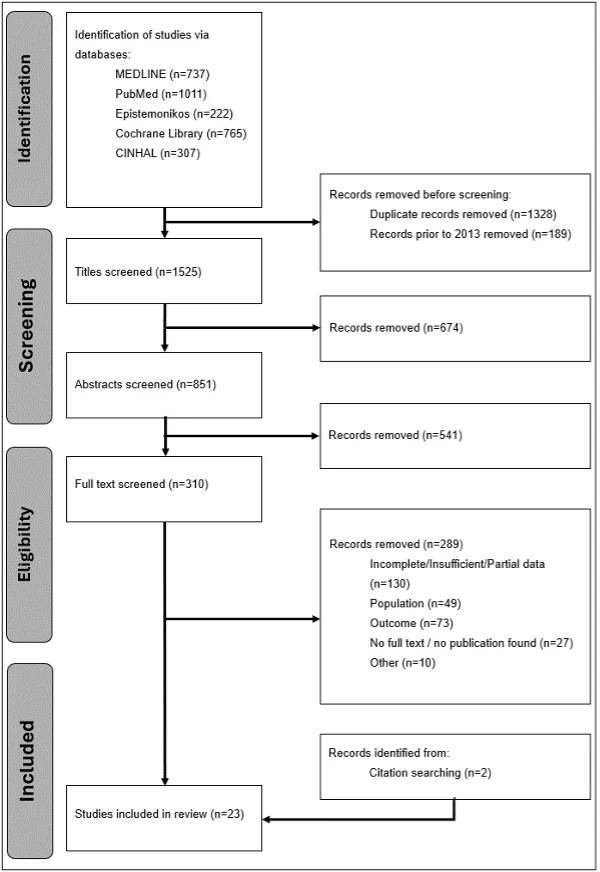
The literature search initially yielded 3042 publications, which were screened using the software Rayyan13. After removing duplicates and publications prior to 2013, a total of 1525 entries were identified for the subsequent review process. After reviewing the titles and summaries, a further 1215 articles had to be excluded. 310 publications from the literature search were read in full and evaluated in line with the objectives of this study. The main reason for exclusion at this stage of the review was the way the data were presented, as these could usually not be assigned to a specific point in the stage of MM treatment, since the results of the assessments were summarised across several lines of therapy. This applied particularly to research dealing with relapsed or refractory MM (RRMM). Furthermore, data were presented only as difference values or were shown in progress graphs without stating the clear data. Other frequent exclusion criteria were the combination of different haematological cancers in the study population or endpoints that did not serve the purpose of this integrative review. During the review of the full texts, the reference lists were also checked for potentially relevant literature. In the end, 21 articles from the database search and two from the reference list search were included in this integrative review. Figure 1 shows the Preferred Reporting Items for Systematic Reviews and Meta-Analyses (PRISMA) flow diagram that illustrates the identification and selection process, as well as the rationale behind exclusion.
Figure 1: PRISMA flow diagram.
Abbreviations: PRISMA = Preferred Reporting Items for Systematic Reviews and Meta-Analyses
As shown in Table 2, the included studies vary in terms of study type. Fifteen of the 23 studies are sub-studies. These were designed to analyse data from primary studies that included HrQoL as a secondary outcome. The publications included in the analysis comprise six non-randomised clinical trials (nRCT), four observational studies and 13 randomised clinical trials (RCT), in accordance with the above-mentioned premise. Of these RCTs, ten were designed as unblinded or open-label studies. Six publications cite the HRQoL of patients with MM as the primary endpoint. With regard to the HRQoL instruments used, 22 studies report data collected using the EORTC QLQ-C30. Eleven also used the EORTC QLQ-MY20 and two used the EORTC QLQ-MY24. Furthermore, the EQ-5D was used in six studies, the Brief Pain Inventory (BPI) in two, and the Functional Assessment of Cancer Therapy – Multiple Myeloma (FACT-MM) and the Short Form Health Survey 36 Items (SF-36) in one study each.
Table 2: Summary of included Studies
| Author Year | Study Design | Country | Population | N | HrQoL Instruments | Endpoint HrQoL |
|---|---|---|---|---|---|---|
| O'Donnell 201830 | nRCT | US | NDMM | 50 | EORTC QLQ-C30; EORTC QLQ-MY20 | Secondary |
| Abonour 201831 | nRCT | US | NDMM | 550 | FACT-MM; EQ-5D; BPI | Secondary |
| Ahmedzai 201932 | RCT | UK | RRMM | 288 | EORTC QLQ-C30; EORTC QLQ-MY20; BPI | Primary |
| Delforge 202233 | nRCT | Multinational | RRMM | 126 | EORTC QLQ-C30; EQ-5D | Secondary |
| Despiégel 201934 | Observational | France | NDMM; RRMM | 402 | EORTC QLQ-C30 | Primary |
| Dimopoulos 201335 | RCT | Multinational | NDMM | 459 | EORTC QLQ-C30; EORTC QLQ-MY20 | Secondary |
| Korde 202336 | Observational | US | NDMM | 40 | EORTC QLQ-C30; EORTC QLQ-MY20 | Secondary |
| Maschio 201937 | nRCT | Italy | NDMM | 25 | EORTC QLQ-C30 | Secondary |
| Delforge 201538 | RCT | Multinational | NDMM | 1623 | EORTC QLQ-C30; EORTC QLQ-MY20; EQ-5D | Secondary |
| Nielsen 202039 | RCT | Multinational | NDMM | 553 | EORTC QLQ-C30; EORTC QLQ-MY20 | Secondary |
| Nielsen 201840 | RCT | Denmark | NDMM | 55 | EORTC QLQ-C30 | Secondary |
| Fischer 202229 | Observational | Germany | NDMM | 70 | EORTC QLQ-C30 | Primary |
| Asrar 202141 | nRCT | India | NDMM | 121 | EORTC QLQ-C30; EORTC QLQ-MY20 | Primary |
| Schjesvold 202042 | RCT | Multinational | NDMM | 637 | EORTC QLQ-C30; EORTC QLQ-MY20 | Secondary |
| Perrot 202143 | RCT | Multinational | NDMM | 737 | EORTC QLQ-C30; EQ-5D | Secondary |
| Ramsenthaler 201644 | Observational | UK | NDMM; RRMM | 557 | EORTC QLQ-C30; EORTC QLQ-MY20; EQ-5D | Primary |
| Richardson 2022 [45] | RCT | US | NDMM | 722 | EORTC QLQ-C30; EORTC QLQ-MY20 | Secondary |
| Ludwig 201346 | RCT | US | NDMM | 98 | EORTC QLQ-C30 | Secondary |
| Roussel 202047 | RCT | Multinational | NDMM | 1085 | EORTC QLQ-C30; EORTC QLQ-MY20 | Secondary |
| Royle 201848 | RCT | UK | NDMM | 1061 | EORTC QLQ-C30; EORTC QLQ-MY24 | Secondary |
| Knop 202149 | RCT | Multinational | NDMM | 706 | EORTC QLQ-C30; EQ-5D | Secondary |
| Etto 201150 | nRCT | Brasilia | NDMM | 49 | EORTC QLQ-C30; SF-36 | Primary |
| Verelst 201151 | RCT | Netherlands | NDMM | 284 | EORTC QLQ-C30; EORTC QLQ-MY24 | Secondary |
Data evaluation
The validated Mixed Methods Appraisal Tool (MMAT) version 2018 was used to critically evaluate the different designs of this integrative review of the 23 included studies14. The authors of the evaluation tool explicitly advise against grading the studies. Rather, the assessment of the individual criteria should be presented in a comparison. The recommended user manual was used to make the tool easier to use. The critical evaluation of the included studies was also carried out by an independent reviewer. Any disagreements between the evaluators were resolved by mutual agreement. In general, it can be said that the quality can mostly be described as moderate.
Data analysis
In accordance with the recommendations of Whittemore and Knafl12, the data were iteratively organised, coded, categorised and summarised in the sense of a constant comparison in a meaningful and unbiased manner, in order to arrive at a coherent and integrated conclusion on the research objectives. Thus, the data were extracted from the sources after reading the included studies several times and compiled clearly in a matrix for each source. The data from several sources were summarised into specific variables or subgroups by means of the data presentation. The presentation of the combined data in the form of tables, matrices and diagrams was intended to visualise patterns and relationships. In addition, the extracted data and their analysis were double checked by the authors and the synthesis evaluated.
Harmonisation of HRQoL Data and Disease Stages
The included studies demonstrated substantial heterogeneity regarding study design, patient populations, treatment regimens, HRQoL instruments, and, most importantly, the timing and description of HRQoL assessments. To enable the development of a coherent CIT, a structured harmonisation process was performed.
First, all reported HRQoL assessment time points were extracted from the included studies together with the terminology used by the original authors. Assessment points ranged from diagnosis and treatment initiation to induction therapy, ASCT, maintenance therapy, and subsequent treatment lines. Because identical clinical situations were often described using different terms across studies, a direct comparison of individual assessment time points was not possible. In a second step, assessment points were mapped onto clinically meaningful disease stages derived from the CIT model proposed by Corbin and Strauss10 and adapted to the treatment pathway of MM. This process resulted in a predefined framework comprising diagnosis (1.0), start of treatment (x.1), induction therapy (x.2), post-induction phase (x.3), pre-ASCT phase (x.4), ASCT (x.5), post-ASCT phase (x.6), ongoing treatment (x.7), maintenance therapy (x.8), and end of treatment (x.9). The variable “x” denotes the respective line of therapy. Where multiple studies reported HRQoL data for conceptually equivalent clinical situations despite differences in terminology or exact timing, these data were assigned to the same disease stage. For example, assessments described as “baseline”, “prior to treatment initiation”, or “before cycle one” were grouped within the start-of-treatment stage. Similarly, assessments conducted during maintenance treatment were assigned to the maintenance stage irrespective of the specific maintenance regimen used. To minimise the influence of outliers and variations between studies, median values were used to synthesise HRQoL outcomes across studies assigned to the same disease stage. The purpose of this harmonisation process was not to generate pooled effect estimates but to identify patterns and trends in HRQoL across the disease course. Consequently, the resulting trajectory should be interpreted as a descriptive representation of patient experiences across clinically relevant stages of MM rather than as a quantitative meta-analytic model. This approach enabled the integration of heterogeneous HRQoL data into a unified CIT framework while preserving the clinical relevance of the original assessment time points.
Results
The chronic illness trajectory based on the global health status
Of the 23 studies included in the integrative review, 22 employed the EORTC QLQ-C30, from which the Global Health Status (GHS) scale was identified as the most appropriate indicator for mapping the CIT. The authors of the EORTC QLQ-C30 describe the GHS as the value that should be understood as a summary measure of the patient’s HRQoL 15. The GHS is presented on a scale from 0 to 100. A higher value on the scale indicates a higher HrQoL. Figure 2 shows the number of studies in which GHS data were assigned to a specific disease stage.
Figure 2: Distribution of included Studies, whose GHS data could be assigned to a specific stage of disease.
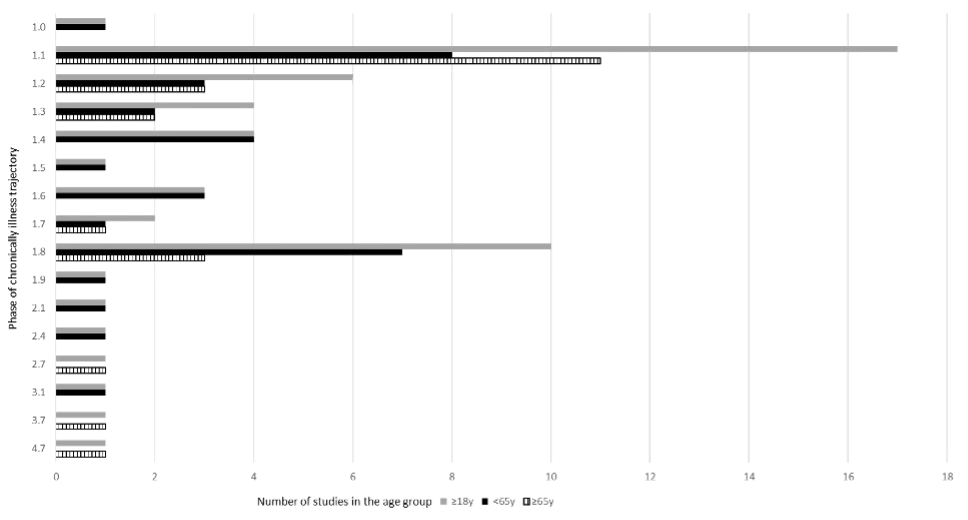
GHS data from one study were assigned to the diagnosis stage (1.0). Seventeen studies provided GHS values corresponding to the initiation of first-line treatment (1.1), six to the induction phase (1.2), four to the post-induction phase (1.3), four to the pre-stem cell transplantation (SCT) stage (1.4), one to the time point of SCT (1.5), three to the post-SCT phase (1.6), two to the stage of ongoing treatment (1.7), ten during maintenance therapy (1.8), and one study provided data for the end-of-treatment phase (1.9). In second-line therapy, one study each contributed GHS data for the stages start of treatment (2.1), pre-SCT (2.4), and ongoing treatment (2.7). Similarly, one study reported data for both start of treatment (3.1) and ongoing treatment (3.7) in third-line therapy, and one study provided data for ongoing treatment in fourth-line therapy (4.7). Overall, these assignments resulted in 16 distinct time points along the CIT. As the CIT begins in healthy individuals and develops even before the actual diagnosis, data from the general population has been included at the start of the chronic illness trajectory (0) 16. Figure 3 shows the CIT for patients with MM aged 18 years and older based on GHS data. To synthesise the GHS data across studies, the median was used as a more robust measure less sensitive to outliers. Eight publications defined an age threshold of either ≤65 or >65 years for their study samples. This cut-off reflects the conventional age criterion used in clinical decision-making regarding eligibility for ASCT 17,18. However, we have not included a separate presentation of these age groups, as the curves are virtually identical. Data for the ≥65s group is missing only during the SCT phase. According to Corbin & Strauss 10, five distinct phases of the CIT can be identified: the trajectory onset, the crisis phase, the stable and unstable phases, and an acute phase during the ASCT.
Figure 3: Chronic illness trajectory of patients with multiple myeloma based on global health status data from EORTC QLQ-C30.
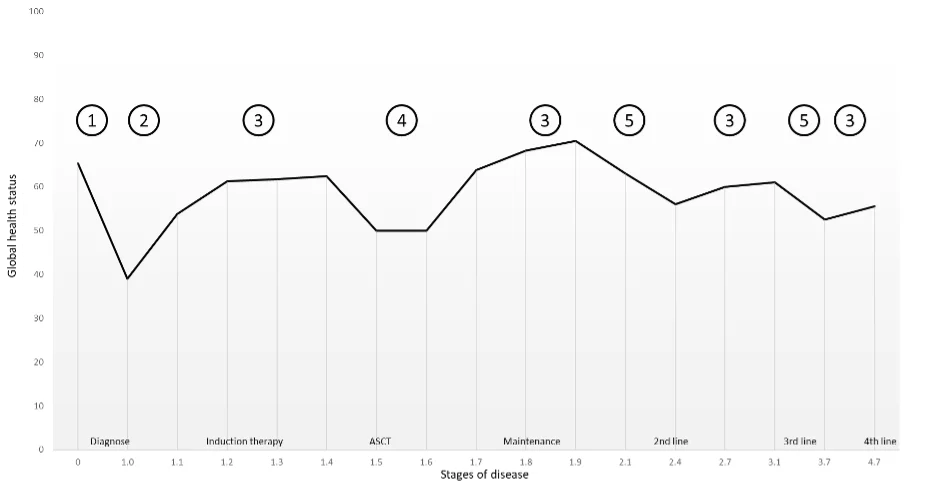
1 = trajectory onset; 2 = crisis; 3 = stable phase; 4 = acute phase; 5 = un-stable phase
Across all treatment phases, GHS values indicate marked impairment at diagnosis, followed by gradual improvement during induction and maintenance therapy. A pronounced temporary decline can be observed around ASCT, reflecting the burden of intensive treatment. Although periods of recovery are evident during stable phases of the disease, each subsequent treatment line is associated with lower overall GHS scores, suggesting cumulative disease- and treatment-related burden over time. The CIT therefore reflects alternating phases of deterioration and recovery, with an overall trend towards declining HRQoL throughout the disease course.
The chronic illness trajectory based on the functional domains
The EORTC QLQ-C30 also includes several items dealing with physical, emotional, social, cognitive and role function 15. These five areas of functioning are mapped on a scale from zero to 100. Higher values indicate a higher or healthier level of functioning.
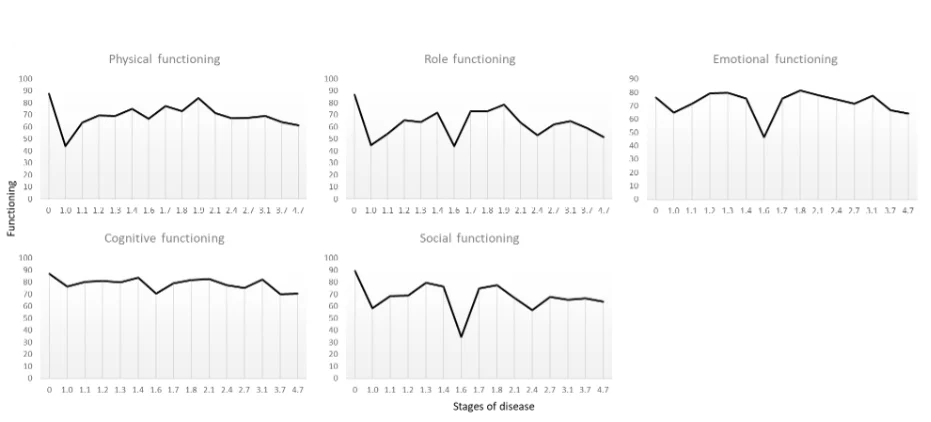
One publication provided data for all five functional domains of the EORTC QLQ-C30 at the diagnosis stage (1.0). During the initiation of first-line treatment (1.1), data were available from 15 studies for physical functioning, 11 for role functioning, and 10 studies each for emotional, cognitive, and social functioning. For the induction therapy phase (1.2), seven studies contributed data on physical functioning, four on role functioning, and two studies each on emotional, cognitive, and social functioning. At the post-induction stage of first-line treatment (1.3), two publications provided data across all five functional domains. In the pre-ASCT phase (1.4), three studies each reported data on physical and role functioning, while two studies contributed data for emotional, cognitive, and social functioning. No data could be assigned to the ASCT time point (1.5) itself during first-line therapy. For the post-ASCT phase (1.6), three studies provided data on physical and role functioning, whereas one study each reported outcomes for emotional, cognitive, and social functioning. A comparable pattern was observed for the stage of ongoing treatment (1.7), although in this phase two studies provided data on physical and role functioning. During maintenance therapy (1.8), data were available from nine studies for physical functioning, seven for role functioning, and eight studies each for emotional, cognitive, and social functioning. At the end-of-treatment stage of first-line therapy (1.9), no data were available for emotional, cognitive, or social functioning, while at least one study reported data for both physical and role functioning. From the second line of treatment onwards, one study each provided data across all five functional domains (2.1 – 4.7).
Across all five functional domains, a consistent pattern emerged. Physical and role functioning were most strongly impaired at diagnosis and during intensive treatment phases, particularly around ASCT, followed by partial recovery during maintenance and disease-control phases. Emotional, cognitive, and social functioning appeared comparatively more stable but also demonstrated deterioration during periods of increased disease burden and treatment intensity. Overall, the functional scales suggest that patients experience recurring disruptions in daily functioning throughout the disease course, with progressively lower levels of functioning observed in later treatment lines. The CIT based on the functional domains for patients aged 18 and older can be found in Figure 4.
Figure 4: Chronic illness trajectories of patients with multiple myeloma based on the functional scales of the EORTC QLQ-C30.
The chronic illness trajectory curve based on the symptom scales
In addition to the GHS and the five functional domains, nine symptoms can also be recorded using the EORTC QLQ-C30. Fatigue, pain, nausea and vomiting are each based on several items in the questionnaire, while the other symptoms are assessed using individual items 15. The results of the questionnaire evaluation are presented on a scale of 0 to 100, where, in contrast to the GHS and the functional domains, a higher value indicates a higher symptom burden.
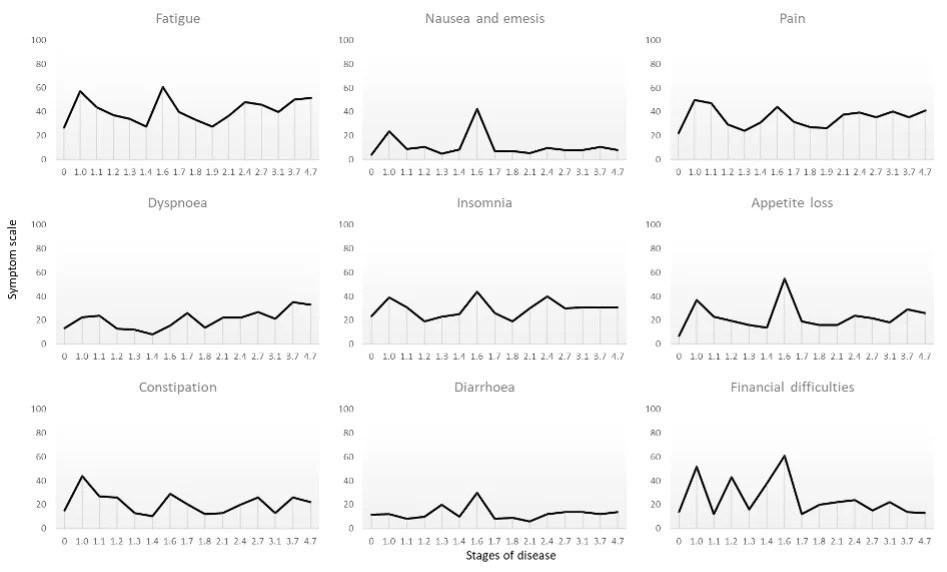
One study included in this integrative review reported data across all nine symptom scales of the EORTC QLQ-C30. For the initiation of first-line treatment (1.1), data from up to 12 publications were available, enabling the most comprehensive analysis at this stage. During the induction therapy phase (1.2), symptom data could be extracted from a maximum of five studies. Three studies each contributed data for the phases post-induction therapy (1.3) and pre-ASCT (1.4). No data were available for the ASCT phase (1.5) itself. For both the post-ASCT (1.6) and ongoing treatment phases (1.7) in first-line therapy, symptom data were available from two publications per stage. The maintenance therapy phase (1.8) was represented by eight studies. At the end-of-treatment stage (1.9), one study provided data, and this was limited to two of the nine symptom scales. From the second line of treatment onwards, one study provided symptom data for each subsequent disease stage (2.1 – 4.7).
Unlike the functional domains, which demonstrated partial recovery during stable phases, several symptoms persisted throughout the disease course. This finding suggests that improvements in overall HRQoL may coexist with ongoing symptom burden, emphasising the need for continuous supportive care even during periods of apparent disease control. Figure 5 shows the CIT for the nine symptoms assessed by the EORTC QLQ-C30.
Figure 5: Chronic illness trajectories of patients with multiple myeloma based on the symptom scales of the EORTC QLQ-C30.
Discussion
To the best of our knowledge, this is the first study to address the development of a CIT for patients with MM based on HrQoL data. The findings indicate that patients experience a a substantial and persistent symptom burden throughout the disease course and across treatment phases, with HrQoL generally declining with each additional line of therapy 19,20. Based on the studies included in this review, key phases of the disease could be identified in accordance with the trajectory model proposed by Corbin and Strauss10 and adapted to the specific clinical and therapeutic characteristics of MM. This model provides a conceptual framework to capture the dynamic and complex progression of chronic illness. Given the heterogeneity of disease manifestation and treatment response in MM, the trajectory presented here should be interpreted as a generalised representation rather than a deterministic course.
Five principal phases with associated subphases were identified: trajectory onset, crisis, acute phase including ASCT, and subsequent stable and unstable phases. The onset phase is characterised by prominent symptoms such as fatigue and bone pain, which negatively affect physical and role functioning. Correspondingly, low Global Health Status (GHS) scores at diagnosis reflect a high level of HrQoL impairment at this stage 1. The transition from onset to crisis is typically marked by the formal diagnosis and the initiation of intensive treatment. The acute phase encompasses complications and acute disease manifestations that often necessitate inpatient care. ASCT, including the preparatory period, transplant, and the recovery period, represents a particularly intensive treatment experience and is associated with a marked temporary worsening of symptoms and functional impairment. In particular, financial difficulties and symptoms such as nausea, vomiting, sleep disorders and dyspnoea exacerbate the burden on patients21,22,23. In addition to physical effects, this phase has considerable emotional and social implications, as patients are confronted with heightened awareness of their illness and may experience social isolation. The stable phase is characterised by periods of relative disease control. Although HrQoL tends to decline across successive lines of therapy, the available data suggest that overall quality of life is comparatively less impaired during stable periods than during acute or unstable phases. Physical and role functioning often show partial recovery, whereas symptoms such as fatigue, dyspnoea, and sleep disturbances remain persistent and burdensome. The unstable phase, marked by loss of disease control, appears to precede clinically confirmed relapse and is associated with progressive deterioration in both functional status and symptom burden. A distinct terminal or decline phase, as described in the original trajectory model, could not be clearly identified in the available data. This may be attributable to ethical constraints in conducting longitudinal HrQoL assessments in advanced disease stages, as well as to limited follow-up durations in the included studies24,25.
Nearly all studies included in this review used the EORTC QLQ-C30 to assess HrQoL, consistent with expert recommendations for oncology research26. However, not all domains particularly relevant to MM—such as sexual functioning—were consistently captured. Previous research has therefore recommended combining multiple patient-reported outcome (PRO) instruments to achieve a more comprehensive assessment of quality of life26. The ongoing development of PRO measures specifically tailored to patients with haematological malignancies represents an important step towards improving clinical assessment and patient-centred care. The overall quality of HrQoL data collection and reporting showed considerable variability across studies26,27. Differences in study design, treatment regimens, attrition rates, and outcome reporting limited direct comparability. A key methodological challenge was the lack of standardisation regarding assessment time points, instruments used, and reporting formats. In addition, the comparability of study populations was restricted, as samples were typically centred around a mean age of approximately 61.5 years and did not consistently account for relevant covariates such as comorbidities or socioeconomic status28. Finally, relatively few studies comprehensively assessed psychological well-being and pain, despite their particular relevance in MM8,29.
Strengths and limitations
This integrative literature review was designed and conducted in accordance with the methodological framework proposed by Whittemore and Knafl12. A comprehensive literature search was performed across five major scientific databases using structured search strategies that were peer-reviewed by an experienced medical librarian. The application of the PICO framework approach facilitated the systematic identification of relevant publications. Transparency and methodological rigour were further enhanced through the use of a PRISMA flow diagram to document the study selection process and through detailed reporting of all methodological steps. The inclusion of randomised controlled trials, non-randomised controlled studies, and observational studies enabled the synthesis of a broad and representative evidence base on HrQoL in patients with MM. To strengthen the validity of the data synthesis, the extraction and assignment of HrQoL outcomes to CIT phases were reviewed by an experienced myeloma nurse specialist, and study quality assessments were conducted through consensus with an independent reviewer.
Despite these strengths, several limitations must be acknowledged. One of the predefined research objectives, namely, determining whether a sufficient number of studies exist to support the construction of a comprehensive CIT based on quantitative HrQoL data, could not be conclusively addressed. In several phases of the trajectory, the CIT relied on data derived from a single study, limiting the robustness of phase-specific conclusions. Furthermore, 130 studies were excluded during eligibility screening because their HrQoL data were either incompletely reported or presented in formats that precluded extraction and allocation to specific disease stages. In many publications, particularly those focusing on relapsed or refractory MM (RRMM), HrQoL outcomes were aggregated across multiple lines of therapy or across several time points within a single treatment line. This reporting practice prevented integration of these data into the trajectory model. Although several authors indicated that access to individual-level data could be granted upon request, direct data acquisition was not pursued due to feasibility constraints, including time and resource limitations.
An additional limitation relates to the aggregation of HrQoL data across different treatment regimens. A more granular differentiation by therapeutic modality might have enhanced the clinical specificity and interpretability of the CIT, potentially allowing more precise identification of intervention points. However, given the limited availability of data within individual disease phases, further stratification was not methodologically feasible without compromising the continuity of the trajectory model.
Finally, the review was conducted within the practical constraints of a single-researcher project with limited personnel, time, and financial resources. These factors may have influenced the scope of data retrieval, the depth of subgroup analyses, and the extent of external validation.
Conclusion
The CIT developed in this review provides a phase-specific framework for understanding the progression of MM from a HrQoL perspective. The identification of distinct disease phases and their associated symptom burden and functional impairment offers clinically relevant insights into how the impact of MM and its treatment evolves over time. The observed patterns of HrQoL change are consistent with previous MM research; however, this study represents the first attempt to synthesise these data into a trajectory-based model that illustrates phase-specific effects across multiple HrQoL domains. Despite these contributions, the available evidence remains limited in several phases of the CIT. Consequently, further empirical research is required to strengthen and validate the proposed trajectory model and to improve the precision of phase-specific HrQoL estimates. The findings also highlight substantial heterogeneity in the assessment and reporting of HrQoL in MM research. The widespread use of the EORTC QLQ-C30 provides a valuable foundation for comparability; however, inconsistencies in data collection time points, reporting formats, and domain coverage limit cross-study synthesis. Establishing HrQoL as a primary or co-primary endpoint in MM clinical research would facilitate more standardised and comparable outcome reporting.
Recommendations for research and clinical practice
The phase-specific insights generated by the CIT suggest several directions for future research and clinical practice. First, there is a clear need to further standardise HrQoL data collection in MM studies, including harmonised assessment schedules and consistent reporting of domain-specific results. In addition, the development and validation of complementary patient-reported outcome instruments addressing domains insufficiently covered by existing tools, such as financial toxicity, mental health, and treatment-related psychosocial effects, would enable a more comprehensive evaluation of patient well-being.
Although the derivation of concrete clinical practice guidelines was beyond the scope of this work, the identified trajectory phases allow for the formulation of preliminary, phase-oriented recommendations for supportive care. Structured self-management support should be integrated throughout the disease course, with interventions tailored to the specific challenges of each trajectory phase. For example, patients at diagnosis and during induction therapy may benefit from intensified symptom assessment, education, and psychosocial support, whereas supportive care interventions during ASCT should focus on managing treatment-related symptom burden and functional decline. During maintenance and stable phases, the trajectory may facilitate self-management support and long-term survivorship planning. Furthermore, recognising periods of increasing symptom burden may help clinicians identify patients at risk of deterioration and initiate timely supportive interventions.
The CIT developed in this review primarily reflects patient experiences during clinically relevant treatment phases rather than biological disease evolution alone. Since HRQoL assessments are generally collected within treatment studies, the resulting CIT should be interpreted as a combined disease-treatment trajectory. Future studies integrating biological markers, disease stage, cytogenetic risk, and patient-reported outcomes may allow the development of biologically stratified trajectories.
The CIT further demonstrates a cumulative deterioration of HrQoL domains with each additional line of therapy, underlining the importance of early and continuous supportive care. In advanced disease stages, including phases of decline and end-of-life care, evidence from palliative care research provides an established framework for symptom control and psychosocial support, which should be integrated into MM care pathways. Overall, the trajectory-based perspective introduced in this study supports a more dynamic and patient-centred approach to MM management and underscores the need for longitudinal, standardised HrQoL assessment to inform both clinical decision-making and future research.
License
© Author(s) 2026.
This is an open-access article distributed under the terms of the Creative Commons Attribution 4.0 International License (CC BY 4.0), which permits unrestricted use, distribution, and reproduction in any medium, and unrestricted adaptation and reuse, including for commercial purposes, provided you give appropriate credit to the original author(s) and the source, provide a link to the Creative Commons license, and indicate if changes were made.
To view a copy of this license, visit https://creativecommons.org/licenses/by/4.0/.
References
-
Brigle K, Rogers B. Pathobiology and diagnosis of multiple myeloma. Semin Oncol Nurs. 2017;33(3):225-36.
-
Huang J, Chan SC, Lok V, Zhang L, Lucero-Prisno DE, Xu W, et al. The epidemiological landscape of multiple myeloma: a global cancer registry estimate of disease burden, risk factors, and temporal trends. Lancet Haematol. 2022;9(9):e670-7.
-
Röllig C, Knop S, Bornhäuser M. Multiple myeloma. Lancet. 2015;385(9983):2197-208.
-
Kumar SK, Rajkumar SV, Dispenzieri A, Lacy MQ, Hayman SR, Buadi FK, et al. Improved survival in multiple myeloma and the impact of novel therapies. Blood. 2008;111(5):2516-20.
-
Cowan AJ, Green DJ, Kwok M, Lee S, Coffey DG, Holmberg LA, et al. Diagnosis and management of multiple myeloma: a review. JAMA. 2022;327(5):464-77.
-
Landgren O, Iskander K. Modern multiple myeloma therapy: deep, sustained treatment response and good clinical outcomes. J Intern Med. 2017;281(4):365-82.
-
Ricciuti G, Falcone A, Cascavilla N, Martinelli G, Cerchione C. Autologous stem cell transplantation in multiple myeloma. Panminerva Med. 2020;62(4):220-4.
-
Ramsenthaler C, Osborne TR, Gao W, Siegert RJ, Edmonds PM, Schey SA, et al. The impact of disease-related symptoms and palliative care concerns on health-related quality of life in multiple myeloma: a multi-centre study. BMC Cancer. 2016;16:427.
-
Palumbo A, Avet-Loiseau H, Oliva S, Lokhorst HM, Goldschmidt H, Rosinol L, et al. Revised International Staging System for multiple myeloma: a report from International Myeloma Working Group. J Clin Oncol. 2015;33(26):2863-9.
-
Corbin JM. The Corbin and Strauss chronic illness trajectory model: an update. Sch Inq Nurs Pract. 1998;12(1):33-41.
-
Rajkumar SV, Harousseau JL, Durie B, Anderson KC, Dimopoulos M, Kyle R, et al. Consensus recommendations for the uniform reporting of clinical trials: report of the International Myeloma Workshop Consensus Panel 1. Blood. 2011;117(18):4691-5.
-
Whittemore R, Knafl K. The integrative review: updated methodology. J Adv Nurs. 2005;52(5):546-53.
-
Ouzzani M, Hammady H, Fedorowicz Z, Elmagarmid A. Rayyan—a web and mobile app for systematic reviews. Syst Rev. 2016;5:210.
-
Hong QN, Pluye P, Fàbregues S, Bartlett G, Boardman F, Cargo M, et al. Improving the content validity of the mixed methods appraisal tool: a modified e-Delphi study. J Clin Epidemiol. 2019;111:49-59.
-
Aaronson NK, Ahmedzai S, Bergman B, Bullinger M, Cull A, Duez NJ, et al. The European Organization for Research and Treatment of Cancer QLQ-C30: a quality-of-life instrument for use in international clinical trials in oncology. J Natl Cancer Inst. 1993;85(5):365-76.
-
Nolte S, Liegl G, Petersen MA, Aaronson NK, Costantini A, Fayers PM, et al. General population normative data for the EORTC QLQ-C30 health-related quality of life questionnaire based on 15,386 persons across 13 European countries, Canada and the Unites States. Eur J Cancer. 2019;107:153-63.
-
Mian H, Mian OS, Rochwerg B, Foley R, Wildes TM. Autologous stem cell transplant in older patients (age ≥ 65) with newly diagnosed multiple myeloma: a systematic review and meta-analysis. J Geriatr Oncol. 2020;11(1):93-9.
-
Ricciuti G, Falcone A, Cascavilla N, Martinelli G, Cerchione C. Autologous stem cell transplantation in multiple myeloma. Panminerva Med. 2020;62(4):220-4.
-
Fleischer A, Zapf L, Allgaier J, Jordan K, Gelbrich G, Pryss R, et al. A patient survey indicates quality of life and progression-free survival as equally important outcome measures in multiple myeloma clinical trials. J Cancer Res Clin Oncol. 2023.
-
Kirkpatrick S, Campbell K, Harding S. A survey of quality-of-life tools used in the routine care of patients with multiple myeloma. Br J Nurs. 2023;32(5):S10-4.
-
Park J, Look KA. Health care expenditure burden of cancer care in the United States. Inquiry. 2019;56:46958019880696.
-
Seefat MR, Cucchi DGJ, Dirven S, Groen K, Zweegman S, Blommestein HM. A systematic review of cost-effectiveness analyses of novel agents in the treatment of multiple myeloma. Cancers (Basel). 2021;13(22):5606.
-
Neumann M. Beratungsbedürfnisse im Krankheitsverlauf aus Sicht von an einem Multiplen Myelom erkrankten Menschen [unpublished manuscript]. Freiburg: Katholische Hochschule; 2019.
-
Delforge M, Shah N, San-Miguel JF, Braverman J, Dhanda DS, Shi L, et al. Health-related quality of life with idecabtagene vicleucel in relapsed and refractory multiple myeloma. Blood Adv. 2022;6(4):1309-18.
-
Nielsen LK, Stege C, Lissenberg-Witte B, van der Holt B, Mellqvist UH, Salomo M, et al. Health-related quality of life in transplant ineligible newly diagnosed multiple myeloma patients treated with either thalidomide or lenalidomide-based regimen until progression: a prospective, open-label, multicenter, randomized, phase 3 study. Haematologica. 2020;105(6):1650-9.
-
Bladé J, Calleja MÁ, Lahuerta JJ, Poveda JL, de Paz HD, Lizán L. Defining a set of standardised outcome measures for newly diagnosed patients with multiple myeloma using the Delphi consensus method: the IMPORTA project. BMJ Open. 2018;8(2):e018850.
-
Salek S, Ionova T, Oliva EN, Andreas M, Skoetz N, Kreuzberger N, et al. The reporting, use, and validity of patient-reported outcomes in multiple myeloma in clinical trials: a systematic literature review. Cancers (Basel). 2022;14(23):6007.
-
Nielsen LK, Jarden M, Andersen CL, Frederiksen H, Abildgaard N. A systematic review of health-related quality of life in longitudinal studies of myeloma patients. Eur J Haematol. 2017;99(1):3-17.
-
Fischer J, Knop S, Danhof S, Einsele H, Keller D, Löffler C. The influence of baseline characteristics, treatment and depression on health-related quality of life in patients with multiple myeloma: a prospective observational study. BMC Cancer. 2022;22(1):1032.
-
O’Donnell EK, Laubach JP, Yee AJ, Chen T, Huff CA, Basile FG, et al. A phase 2 study of modified lenalidomide, bortezomib and dexamethasone in transplant-ineligible multiple myeloma. Br J Haematol. 2018;182(2):222-30.
-
Abonour R, Wagner L, Durie BGM, Jagannath S, Narang M, Terebelo HR, et al. Impact of post-transplantation maintenance therapy on health-related quality of life in patients with multiple myeloma: data from the Connect MM Registry. Ann Hematol. 2018;97(12):2425-36.
-
Ahmedzai SH, Snowden JA, Ashcroft AJ, Cairns DA, Williams C, Hockaday A, et al. Patient-reported outcome results from the open-label, randomized phase III Myeloma X trial evaluating salvage autologous stem-cell transplantation in relapsed multiple myeloma. J Clin Oncol. 2019;37(19):1617-28.
-
Delforge M, Shah N, San-Miguel JF, Braverman J, Dhanda DS, Shi L, et al. Health-related quality of life with idecabtagene vicleucel in relapsed and refractory multiple myeloma. Blood Adv. 2022;6(4):1309-18.
-
Despiégel N, Touboul C, Flinois A, Saba G, Suzan F, Gonzalez-McQuire S, et al. Health-related quality of life of patients with multiple myeloma treated in routine clinical practice in France. Clin Lymphoma Myeloma Leuk. 2019;19(1):e13-28.
-
Dimopoulos MA, Delforge M, Hájek R, Kropff M, Petrucci MT, Lewis P, et al. Lenalidomide, melphalan, and prednisone, followed by lenalidomide maintenance, improves health-related quality of life in newly diagnosed multiple myeloma patients aged 65 years or older: results of a randomized phase III trial. Haematologica. 2013;98(5):784-8.
-
Korde N, Tavitian E, Mastey D, Lengfellner J, Hevroni G, Zarski A, et al. Association of patient activity bio-profiles with health-related quality of life in patients with newly diagnosed multiple myeloma: a prospective observational cohort study. EClinicalMedicine. 2023;57:101854.
-
Maschio M, Zarabla A, Maialetti A, Marchesi F, Giannarelli D, Gumenyuk S, et al. The effect of docosahexaenoic acid and α-lipoic acid as prevention of bortezomib-related neurotoxicity in patients with multiple myeloma. Integr Cancer Ther. 2019;18:1534735419888584.
-
Delforge M, Minuk L, Eisenmann JC, Arnulf B, Canepa L, Fragasso A, et al. Health-related quality-of-life in patients with newly diagnosed multiple myeloma in the FIRST trial: lenalidomide plus low-dose dexamethasone versus melphalan, prednisone, thalidomide. Haematologica. 2015;100(6):826-33.
-
Nielsen LK, Stege C, Lissenberg-Witte B, van der Holt B, Mellqvist UH, Salomo M, et al. Health-related quality of life in transplant ineligible newly diagnosed multiple myeloma patients treated with either thalidomide or lenalidomide-based regimen until progression: a prospective, open-label, multicenter, randomized, phase 3 study. Haematologica. 2020;105(6):1650-9.
-
Nielsen L, Klausen T, Kristensen I, Frølund U, Andersen N, Andersen C, et al. Clarithromycin added to the VCD regimen causes reduced health-related quality of life in multiple myeloma patients. HemaSphere. 2018;2(S1):659-60.
-
Asrar MM, Lad DP, Bansal D, Prinja S, Khadwal A, Prakash G, et al. Health-related quality of life in transplant eligible multiple myeloma patients with or without early ASCT in the real-world setting. Leuk Lymphoma. 2021;62(13):3271-7.
-
Schjesvold F, Goldschmidt H, Maisnar V, Spicka I, Abildgaard N, Rowlings P, et al. Quality of life is maintained with ixazomib maintenance in post-transplant newly diagnosed multiple myeloma: the TOURMALINE-MM3 trial. Eur J Haematol. 2020;104(5):443-58.
-
Perrot A, Facon T, Plesner T, Usmani SZ, Kumar S, Bahlis NJ, et al. Health-related quality of life in transplant-ineligible patients with newly diagnosed multiple myeloma: findings from the phase III MAIA trial. J Clin Oncol. 2021;39(3):227-37.
-
Ramsenthaler C, Osborne TR, Gao W, Siegert RJ, Edmonds PM, Schey SA, et al. The impact of disease-related symptoms and palliative care concerns on health-related quality of life in multiple myeloma: a multi-centre study. BMC Cancer. 2016;16:427.
-
Richardson PG, Jacobus SJ, Weller E, Hassoun H, Lonial S, Raje NS, et al. Lenalidomide, bortezomib, and dexamethasone (RVd) ± autologous stem cell transplantation (ASCT) and R maintenance to progression for newly diagnosed multiple myeloma (NDMM): the phase 3 DETERMINATION trial. J Clin Oncol. 2022;40(17 Suppl):LBA4.
-
Ludwig H, Viterbo L, Greil R, Masszi T, Spicka I, Shpilberg O, et al. Randomized phase II study of bortezomib, thalidomide, and dexamethasone with or without cyclophosphamide as induction therapy in previously untreated multiple myeloma. J Clin Oncol. 2013;31(2):247-55.
-
Roussel M, Hebraud B, Hulin C, Perrot A, Caillot D, Stoppa AM, et al. Health-related quality of life results from the IFM 2009 trial: treatment with lenalidomide, bortezomib, and dexamethasone in transplant-eligible patients with newly diagnosed multiple myeloma. Leuk Lymphoma. 2020;61(6):1323-33.
-
Royle KL, Gregory WM, Cairns DA, Bell SE, Cook G, Owen RG, et al. Quality of life during and following sequential treatment of previously untreated patients with multiple myeloma: findings of the Medical Research Council Myeloma IX randomised study. Br J Haematol. 2018;182(6):816-29.
-
Knop S, Mateos MV, Dimopoulos MA, Suzuki K, Jakubowiak A, Doyen C, et al. Health-related quality of life in patients with newly diagnosed multiple myeloma ineligible for stem cell transplantation: results from the randomized phase III ALCYONE trial. BMC Cancer. 2021;21(1):659.
-
Etto LY, Morelli V, Silva V, Hungria V, Ciconelli R, Almeida M, et al. Autologous stem cell transplantation improves quality of life in economically challenged, Brazilian multiple myeloma patients. Clinics (Sao Paulo). 2011;66(11):1855-9.
-
Verelst SGR, Termorshuizen F, Uyl-de Groot CA, Schaafsma MR, Ammerlaan AHM, Wittebol S, et al. Effect of thalidomide with melphalan and prednisone on health-related quality of life (HRQoL) in elderly patients with newly diagnosed multiple myeloma: a prospective analysis in a randomized trial. Ann Hematol. 2011;90(12):1427-39.
How to Cite
Naegele M, Neumann M. Chronic illness trajectory of patients with multiple myeloma derived from health-related quality of life data – an integrative review. OncoDaily Med J. 2026;3(1):e005. doi:10.69690/ODMJ-012-0826-7730