


Recovery Kinetics of Serum Albumin in Pediatric Cancer Patients: Its Determinants and Correlation with Outcomes


Abstract
Introduction: Hypoalbuminemia and cancer-cachexia are established predictors of poor survival and increased chemotherapy toxicity in adult cancers. However, limited literature explores these associations in pediatric oncology. Additionally, the recovery kinetics of serum-albumin during therapy and its impact on clinical-outcomes remain poorly understood. This study investigates the determinants and impact of serum albumin levels at various time-points in pediatric cancer patients. Objectives are to analyze trends and determinants of serum-albumin at baseline and during therapy (3, 6, and 12-months), to assess the impact of serum albumin levels on 3-year overall survival (OS) and event-free survival (EFS) and to explore the relationship between hypoalbuminemia and systemic symptoms, nutritional status, inflammatory markers, and treatment-related toxicities.
Methodology: This retrospective study included 402 pediatric cancer patients (≤18years) treated at a single tertiary-center. Baseline systemic symptoms, stage/risk group, nutritional status, serum-albumin at baseline,3-months,6-months and 12-months of therapy were recorded along with outcomes like relapse/death and toxicity. Multivariate-regression, and survival-analysis was conducted using Cox proportional-hazards models to identify the determinants and impact of serial albumin values [Figure-1].
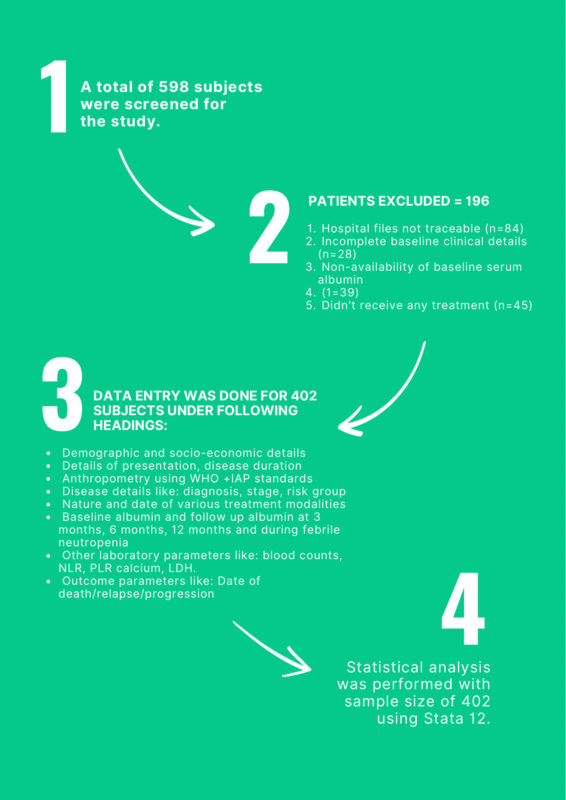
Figure 1: Flow chart depicting our study outline.
Results : A total 402 patients were enrolled, with median age of 4yrs (2.5mo-14yrs), majority being hemato-lymphoid cancers (57.71%). The predictive cut-off albumin was 4.0g/dl [Figure2]. Prevalence of hypoalbuminemia at baseline, 3m and 6m were 46.52%,26.45% and 22.0% respectively. The 3-year overall-survival (OS) was lower for patients with hypoalbuminemia at baseline (44.9% vs 69.8%;HR=2.1,P=0.00), 3m (HR=2.28;P=0.00) or 6m (HR=2.02;P=0.001) in univariate-analysis [Figure-3]. On multivariate-analysis, only risk-group (HR=1.74;P=0.01), 6m albumin (HR=3.33;P=0.00) and first 6m albumin-trend (HR=1.84;P=0.02) were independent predictors of OS.
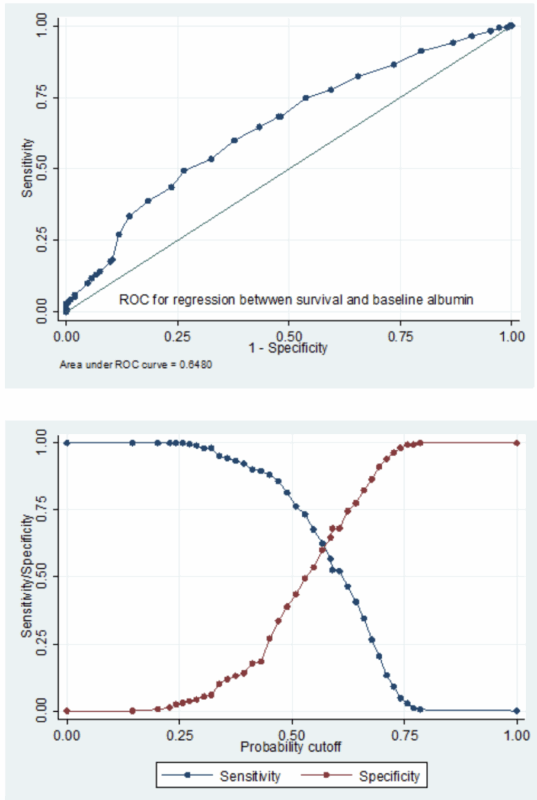
Figure 2: Cut off point estimation using logistic regression between survival or death as a binary dependent variable and baseline albumin as a continuous independent variable (A) ROC of the logistic regression (B) Calculating the maximum Youden’s index from sensitivity/specificity vs probability plot
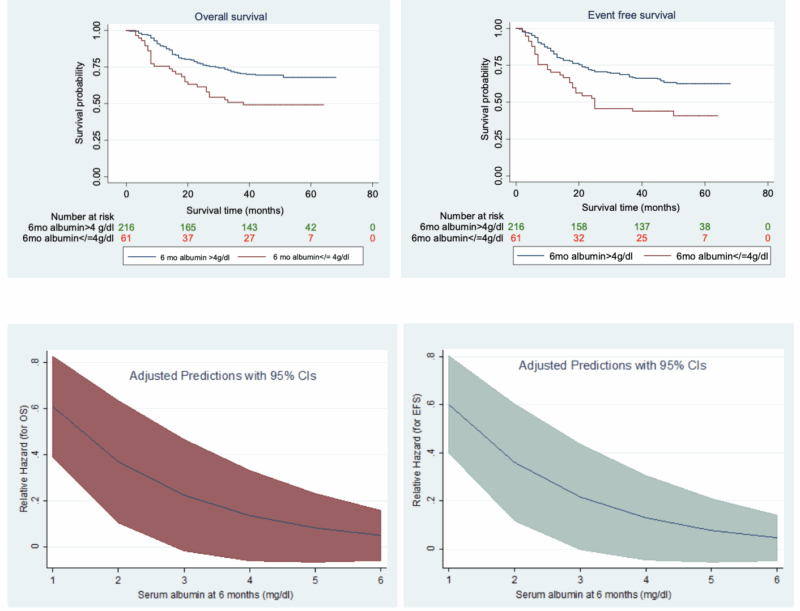
Figure 3: Kaplan-Meier curve depicting the impact of 6-month albumin value on (A) OS and (B) EFS along with margins plot depicting relative hazard as a function of serum albumin at 6 months in relation to (C) OS (D) EFS, in the univariate analysis
Liver/spleen size (r=-0.39) and serum-globulin (r=-0.37) had moderate negative correlation with baseline-albumin.
On multivariate-analysis, systemic-symptoms (OR=8.01,P=0.01) and baseline-malnutrition (OR=2.08;P=0.00) predicted baseline-hypoalbuminemia, while 6-months albumin was dependent only on baseline-systemic-symptoms (OR=5.28;P=0.01) [Figure-4]. Also, hypoalbuminemia at baseline, 3m or 6m was associated with increased risk of febrile neutropenia (OR=1.29;P=0.01) and hospitalization (OR=2.86;P=0.00).
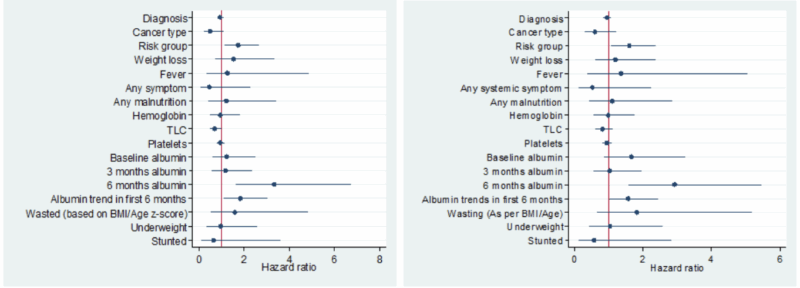
Figure 4: Coefficient plot depicting hazard ratios in the multivariate analysis of factors found significant in univariate analysis for predicting (A) OS (B) EFS
This study emphasizes that serum albumin at 6 months, rather than baseline, is a superior predictor of survival, likely reflecting cancer-related inflammation and cachexia. The findings suggest that albumin recovery-kinetics could serve as a dynamic biomarker for disease progression and response to therapy.
Conclusion: While baseline-albumin is influenced by malnutrition, systemic-symptoms, inflammatory state (hypergammaglobulinemia) and disease-bulk (organomegaly), the 6-months-albumin is independent of baseline-malnutrition and likely a better indicator of the cancer-inflammation-cachexia-cascade to predict disease-outcomes in pediatric-cancers [Figure-5].
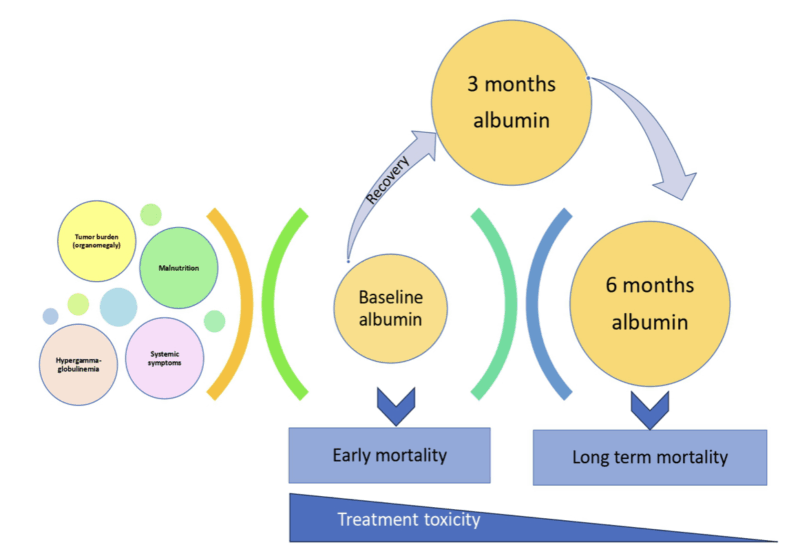
Figure 5: Schematic presentation of serum trends affecting the survival in pediatric cancers
How to Cite
Mohapatra D, Prabhakar P, Seth R, Meena JP, Gupta AK. Recovery Kinetics of Serum Albumin in Pediatric Cancer Patients: Its Determinants and Correlation with Outcomes. OncoDaily Med J. 2025. doi:10.69690/ODMJ-018-0425-2747