


Check-Me-Check Proton Therapy Treatment Plans – A Trainer Package for Physicists
Abstract
Introduction: In proton therapy, multiple checkpoints are essential for ensuring the safe production and delivery of treatment plans. One critical checkpoint involves a physicist independently verifying each plan to ensure its clinical safety and acceptability. However, training plan checkers is challenging due to the lack of a structured process to prepare them for all potential errors. Most plans are error-free, which limits the exposure of checkers to actual mistakes, complicating their training.
A study by Gopan et al. found that only 38% of errors that were potentially detectable during physics plan and chart reviews were identified. Training new plan checkers is particularly challenging in proton beam therapy, given its complexity and the limited number of proton therapy centres, which results in a scarcity of experienced staff. Presented in this work is a training package developed specifically for physicists checking proton plans.
Methodology: A risk-based approach was employed to develop the material, scoring errors based on their severity, occurrence, and detectability. Six clinical plans of varying complexity were selected for this study, with intentional errors introduced into four of the six plans. These errors were assigned different Risk Priority Numbers (RPN = severity × occurrence × detectability). The remaining two plans were left unchanged (Table 1).
Results: Plan checkers in the department were tasked with reviewing the six prepared plans using their standard procedures. They documented their findings and any identified issues in a spreadsheet and made a final determination on whether each plan was clinically safe and acceptable. These results were then compared to the master spreadsheet containing the pre-introduced changes for each plan. The package is also intended to serve as a training tool for new staff before they are approved for conducting independent checks.
Conclusion: A practical training package was developed for proton treatment plan checkers, designed to expose them to potential errors that may occur in treatment plans. Physicists who completed the training found it highly valuable, gaining insights into areas where they might be prone to oversight. The training package will be periodically updated with new plans and introduced errors to maintain its effectiveness.
Table 1: List of intentionally introduced errors with their risk priority number
| Errors introduced – Plan No 1 | Severity | Occurrence | Detectability | RPN |
|---|---|---|---|---|
| HFP instead of HFS position | 3.6 | 3 | 2 | 21.6 |
| Gating Used | 2 | 3 | 2 | 12 |
| Primary reference point dose limit | 4.4 | 2 | 2 | 17.6 |
| Plan name laterality | 1.5 | 3 | 3 | 13.5 |
| Not optimised just calculated | 4.1 | 1.5 | 1.5 | 9.3 |
| Errored Plan No 2 | ||||
| Inappropriate “Body contour” leading to inaccurate proton range calc* | 3.6 | 4.1 | 6.6 | 97.4 |
| Plan Name A2 instead of A1 | 1.5 | 3.1 | 2 | 9.3 |
| Errored Plan No 3 | ||||
| Over-dosing OARs- changed the spots weighting | 3.4 | 4.8 | 6.5 | 106.1 |
| Ting CTV contour outside PTV | 3.1 | 3.5 | 5.6 | 60.8 |
| Errored Plan No 4 | ||||
| Mis-matching data (DOB, Name, Gender) | 3.1 | 3 | 7.7 | 71.6 |
| Wrong Scan ID | 3.1 | 3 | 7.7 | 71.6 |
| Misinformation on history (previous treatment, implants) | 6 | 3 | 6.7 | 120.6 |
| Wrong stopping Power Ratio used for override | 3.4 | 4.8 | 6.5 | 106.1 |
| Wrong CT calibration curve used | 4.4 | 3.2 | 6.7 | 93.3 |
| Wrong laterality on the Plan Name | 1.5 | 3 | 3 | 13.5 |
| Prescription asks for bi-daily but the plan is daily | 2 | 2 | 3 | 12 |
| Incorrect robustness evaluation | 2.9 | 3 | 3 | 26.1 |
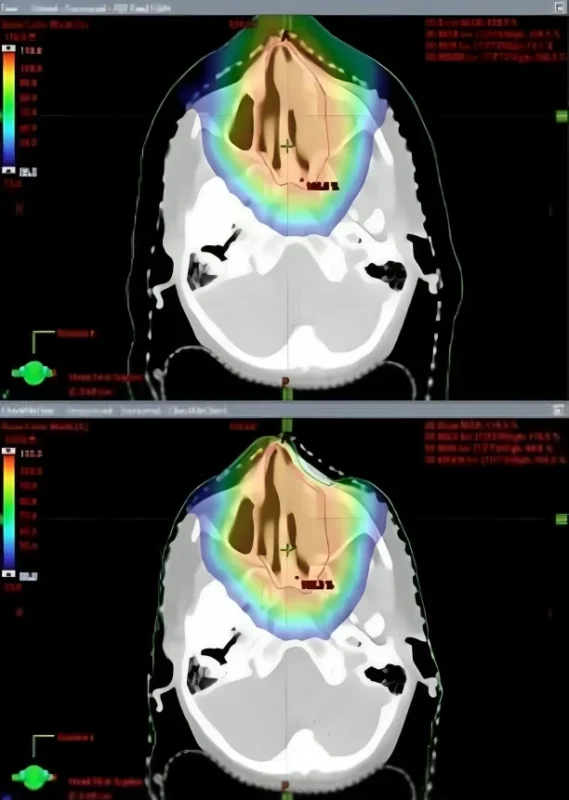
Figure 1: A) The dose distribution of the clinical plan with no error. B) Inappropriate “Body contour” edited intentionally leading to inaccurate proton range calculations.
Conflict of interests: The authors declare no conflict of interest.
Funding: This research received no specific grant from any funding agency in the public, commercial, or not-for-profit sectors.
License: ©️ Author(s) 2026. This is an open access article distributed under the terms of the Creative Commons Attribution 4.0 International License (CC BY 4.0), which permits unrestricted use, distribution, and reproduction in any medium, and unrestricted adaptation and reuse, including for commercial purposes, provided you give appropriate credit to the original author(s) and the source, provide a link to the Creative Commons license, and indicate if changes were made.
To view a copy of this license, visit https://creativecommons.org/licenses/by/4.0/.