


Risk of Atrial Fibrillation in Breast Cancer Patients Treated with Radiotherapy: A Scoping Review


Abstract
Introduction: Cardiovascular diseases (CVD) are common complications among cancer survivors treated with radiotherapy (RT). Breast cancer (BC) survivors can develop a variety of cardiotoxic complications related to cardiac radiation exposure that occurs months to years after RT, with atrial fibrillation (AF) often reported among them.
Purpose: To investigate the potential risk of AF in BC patients treated with RT.
Methods: A scoping review was performed in PubMed, CINAHL, Science Direct, Google Scholar and Scopus between 2015-2026 according to Arksey & O’Malley framework following PRISMA for scoping reviews. Articles written in English were retrieved and read in full by two of the authors. This scoping review was limited to individuals >18 years old, with BC treated by RT and diagnosed with AF. Papers focusing on different CVD’s were excluded.
Results: A total of 5 studies are included in this scooping review. A relationship between age and AF risk in patients treated with RT was shown. It appears that patients (≥65years) were at higher risk of being diagnosed with AF. A significant increase in the incidence of AF was observed in BC patients undergoing RT compared to those who did not receive RT.
Conclusions: The correlation between BC, RT, and AF is a significant source of concern in cancer survivorship treatment. Monitoring of heart implications should be included in long-term follow-up treatment for BC survivors, especially those who received RT. Routine screening for AF and other cardiovascular disorders can assist in the early detection and management of any consequences. Further research into the underlying mechanisms and preventive strategies will be essential to mitigate the cardiovascular risks in BC survivors.
Key words: radiotherapy, breast neoplasm, malignancy, tumour, breast cancer, atrial fibrillation, arrhythmias.
Introduction
Breast Cancer (BC) is characterized by the unfettered development of abnormal cells that develop into tumours and affect millions of people worldwide every year1. In many cases that are diagnosed while the disease is still localized, allowing for a multidisciplinary treatment approach that usually includes surgical intervention, chemotherapy, hormone therapy and radiotherapy (RT)1.
RT is a clinical intervention that utilizes concentrated levels of RT to destroy malignant cells and reduce tumour size. However, administering radiation to the left and right breast unavoidably exposes the heart to some level of radiation2. The average dose the heart receives varies based on the specific target area and the radiation techniques employed. Therefore, systemic treatments may lead to a reduction in the left ventricular efficiency, the development of arrhythmias, and various vascular toxicities 3,4.
Furthermore, radiation to the chest can result in pericardial and myocardial fibrosis, leading to cardiovascular diseases (CVD’s) such as conduction disorders, valvular issues, heart failure (HF), with atrial fibrillation (AF) often reported among them 5,6,7.
Malignant tumours and AF often share a common biological foundation or risk profile, suggesting that AF could serve as a clinical indicator of undiagnosed cancer. Beyond shared contributors like aging, obesity, and tobacco use, the development of AF in cancer patients may be driven by disease-specific factors 8,9. These include systemic inflammation, tissue scarring (fibrosis), and pulmonary micro-embolisms caused by a hypercoagulable state, all of which can act as triggers for arrhythmia 8,9,10.
AF as the most prevalent form of cardiac arrhythmia, is triggered by irregular electrical impulses in the heart’s atria, leading to rapid, uncoordinated contractions 11. While advancements in BC therapies have significantly improved patient survival, they have also led to a rise in secondary cardiovascular complications. Consequently, the management of cancer survivors has become a fundamental component of modern cardiological practice 12,13.
This scoping review explores the effects of RT in BC patients, with a specific emphasis on cardiovascular complications and especially AF. By investigating associated risk factors, this study seeks to address a significant gap in the existing research regarding these complications.
Methodology
Data sources and search strategy
This scoping review was conducted in accordance with the Preferred Reporting Items for Systematic Reviews and Meta-Analyses Extension for Scoping Reviews (PRISMA-ScR) guidelines (Table 1 – supplementary materials). Ethical approval was not required because only published literature was analysed. The review methodology was guided by the Joanna Brings (JBI technique), based on the framework created by Arksey and O’Malley 14, and subsequent methodological refinements. Establishing precise criteria for literature selection and analysis 15. Scoping reviews, unlike systematic reviews, can include a wide range of study designs and are ideal for topics with less research 16. Therefore, a scoping review was chosen. The authors searched PubMed, CINAHL, Science Direct, Google Scholar and Scopus between 2015-2026.
A combination of medical subject headings (MeSH) using (men) OR (women) OR (adult) AND (breast cancer) OR (breast neoplasm) OR (malignancy) OR (tumour) OR (tumour) AND (radiotherapy) OR (radiation therapy) OR (irradiation) AND (atrial fibrillation) OR (arrhythmias) was included in this scoping review (Table 2 – supplementary materials). Keywords including “radiotherapy”, ” breast neoplasm”, “malignancy”, “tumour”, “breast cancer”, “atrial fibrillation”, “arrhythmias” were included.
A scoping review approach was selected because of the emerging and heterogeneous nature of the evidence regarding atrial fibrillation in patients with breast cancer treated with radiotherapy. This methodology allows for the inclusion of a broad range of study designs and facilitates the mapping of the extent and nature of the available evidence, as well as the identification of research gaps.
A comprehensive literature search was conducted in PubMed, CINAHL, Scopus, ScienceDirect, and Google Scholar for studies published between 2015 until 2026. The search strategy was developed using Medical Subject Headings (MeSH), where applicable, and free-text keywords related to three core concepts: 1 breast cancer, 2 radiotherapy, and 3 atrial fibrillation. Boolean operators (“AND” and “OR”) were used to combine search terms within and across concepts. The search strategy was adapted for each database according to its indexing system and search syntax while maintaining the same conceptual framework. No restrictions were applied regarding study design. In addition, the reference lists of all included studies were manually screened to identify any additional relevant publications (the complete search strategies for all databases are provided in Table 3 – supplementary materials).
Study selection
The inclusion criteria were a) articles written in English, b) individuals ≥18 years old, with BC treated by RT and diagnosed with AF, 2) Studies reporting atrial fibrillation risk, incidence, prevalence, association, related to radiotherapy, 3) any radiotherapy setting for breast cancer (adjuvant, neoadjuvant, curative, palliative), 4) full-text peer-reviewed articles, 5) Studies published in English. Exclusion criteria: 1) Pediatric populations, non-breast cancer patients, animal studies, in vitro studies, 2) Studies not reporting atrial fibrillation, studies unrelated to radiotherapy, 3) papers not published in English, editorials, opinions, commentaries, conference abstracts without sufficient data, protocols only, non-peer-reviewed sources, duplicate publications, conferenced proceedings and case reports were excluded. Five studies meeting these criteria were included in the main synthesis of results (reported in Table 4 – supplementary materials).
Description of Included Studies
A total of 500 records were identified through the initial database search (Figure 1). Following the application of the predefined inclusion and exclusion criteria, titles and abstracts were screened.360 duplicate records excluded and 140 unique records remained for screening. Following title and abstract screening, 70 articles were excluded, and 70 full-text articles were assessed for eligibility. Of these, 65 full-text articles were excluded for the following reasons: the study population did not meet the eligibility criteria, radiotherapy exposure was absent or combined with other anticancer therapies without separate analysis, atrial fibrillation was not reported as an outcome (with studies instead focusing on cardiovascular diseases in general), or the study included multiple cancer types rather than exclusively patients with breast cancer. Five articles were chosen for this scoping review.
Figure 1: Flow diagram showing the procedures used to filter the articles for this study using the PRISMA Flow diagram for the scoping review process. 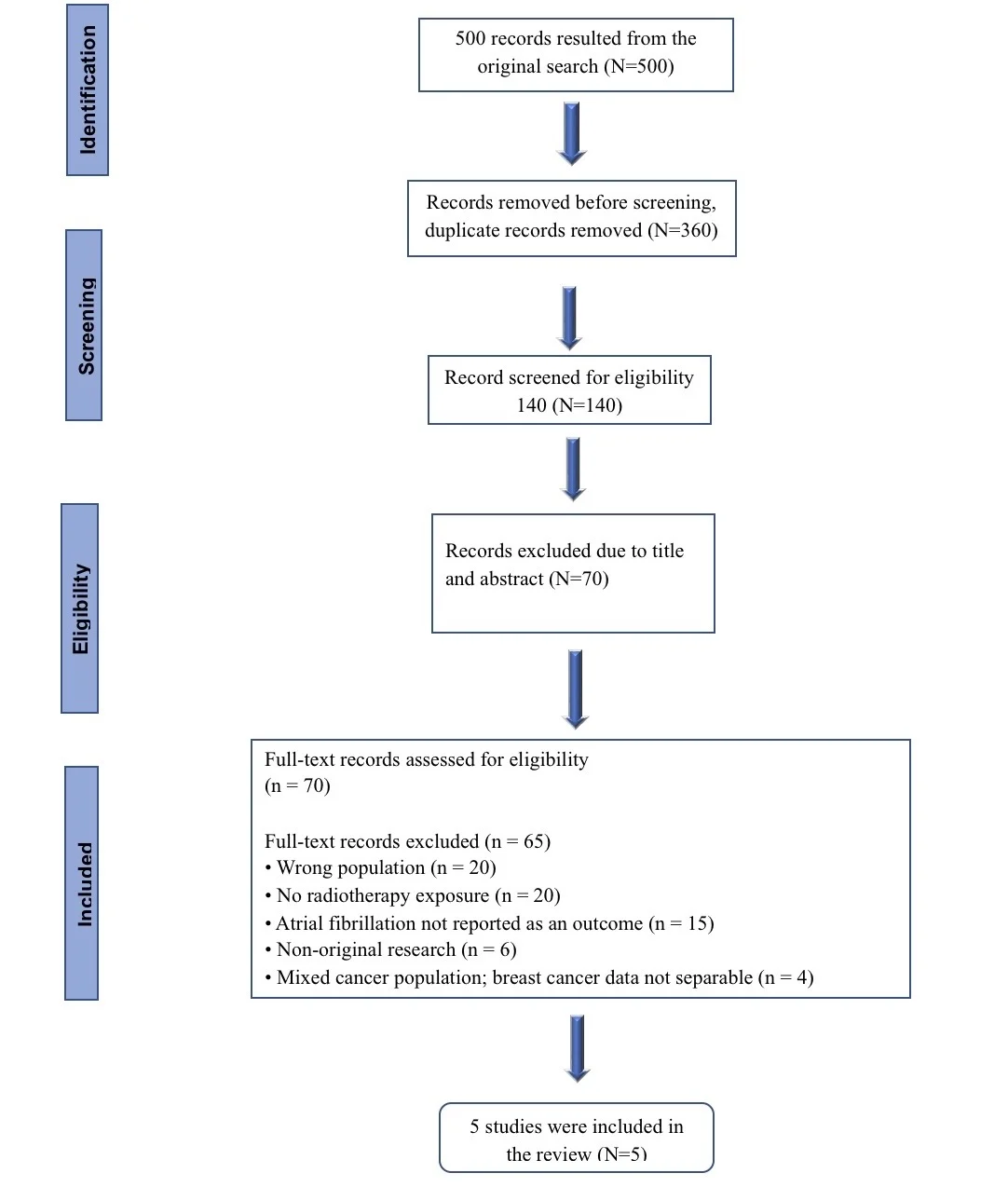
Results
This scoping review synthesizes evidence from five studies examining the association between RT and AF in patients with BC, as well as related outcomes including the influence of age, morbidity, mortality, and length of hospital stay (LOS). Across the included studies, AF emerged as an important cardiovascular complication among patients with BC, with the available evidence suggesting an association between RT exposure and an increased risk of AF or AF related cardiovascular outcomes. The 5 studies included in this scoping review are presented in Table 5 – supplementary materials.
Incidence of AF
In the study of Guha et al. (2022) 17 demonstrated an increased incidence of AF following a diagnosis of BC compared with patients who did not have cancer. Jacobs et al. (2023) 18 reported major adverse cardiovascular events (MACE), which included arrhythmias among other cardiovascular outcomes. Although AF was considered within the broader cardiovascular outcome, AF specific incidence was not reported separately.
Mery et al. (2020) 19 further confirmed that cardiovascular events, including arrhythmias and AF where reported, were increased within 5 years of BC diagnosis. While not all studies isolated RT as the sole exposure, Apte et al. (2021) 20 demonstrated that radiation therapy was independently associated with atrial fibrillation across cancer populations, including patients with breast cancer subgroups where reported.
Guha et al. 17 reported a 1-year cumulative incidence of 3.3% in breast cancer patients, while Mery et al. 19 reported a 5-year cumulative incidence of 1.1% for AF events.
Across the included studies, the reported incidence of atrial fibrillation varied depending on study design, population characteristics, and follow-up duration. Where reported, AF ranged from low single-digit percentages in population-based cohorts to higher rates in older or higher-risk patient groups. Several studies reported only relative risk measures (e.g., hazard ratios or odds ratios) without providing absolute incidence rates, limiting direct comparison across all studies. Overall, the available evidence suggests that AF may occur following BC treatment with RT; however, direct estimates of AF incidence are limited because several studies reported broader cardiovascular outcomes or composite endpoints rather than AF-specific outcomes.
Age associated incidence of AF following BC diagnosis
Guha et al. (2022) 17 found that older BC patients (≥65 years) had a significantly elevated AF risk, with age and comorbid cardiovascular disease being key contributors to this risk. Also, in the studies of Jacobs et al. (2023) 18 and Apte et al. (2021) 20, revealed that age and hypertension having the highest risk to the prevalence of AF.
Incidence of AF associated with left sided radiotherapy
Jacobs et al., (2023) 18 reported an increased risk of cardiovascular events following left-sided breast RT, with higher risk observed in patients receiving left-sided treatment, likely reflecting greater cardiac exposure. However, AF specific laterality analyses were not consistently reported across studies. whereas Apte et al. (2021) 20, demonstrated an association between radiation therapy and atrial fibrillation across cancer populations, including breast cancer, but did not evaluate differences in AF risk between left and right sided breast irradiation due to limited event numbers. Overall, although left sided RT is associated with greater incidental cardiac radiation exposure and an increased risk of broader cardiovascular complications, direct evidence linking treatment laterality to AF remains limited.
Patients receiving RT in their left breast compared to right, had an elevated risk to occur AF. This suggests that radiation exposure to cardiac structures during left sided breast irradiation may contribute to an elevated risk of developing AF. This observation is clinically relevant, as left-sided breast irradiation is more likely to result in incidental exposure of cardiac structures due to the anatomical proximity of the heart to the left haemothorax. Such exposure may contribute to radiation-induced cardiac effects, including myocardial inflammation, fibrosis, and electrical remodelling of atrial tissue, which are recognized mechanisms potentially involved in the development of atrial fibrillation.
Radiotherapy and its specific association with AF
Evidence supporting an association between RT and AF was reported in studies that evaluated radiation exposure as the primary exposure of interest. Apte et al. (2021) 20 found that RT was independently associated with a higher prevalence of AF across cancer populations, including patients with BC.
In the studies of Jacobs et al. (2023) 18 and Mery et al. (2020) 19, reported an increased incidence of major adverse cardiovascular events following RT. These composite outcomes included arrhythmias among other cardiovascular events. However, AF specific estimates were not consistently reported. Risk appeared greater in patients with higher cardiac radiation exposure and pre-existing CVDs. Furthermore, they found that cardiovascular events including AF were significantly increased within 5 years of BC diagnosis, reinforcing the concept of both early and intermediate term cardiovascular susceptibility. Together, these findings suggest that RT is associated with an increased burden of cardiovascular events. Although several studies also reported AF or arrhythmias, the available evidence is insufficient to attribute the observed associations exclusively to AF.
Clinical impact of AF in radiotherapy of mortality and LOS
Beyond incidence, AF and broader cardiovascular complications were associated with worse clinical outcomes. Guha et al. (2022) 17 demonstrated that AF was associated with increased cardiovascular and overall mortality among patients with breast cancer. Jacobs et al. (2023) 18 reported overall mortality, major adverse cardiac events (MACE), AF, and HF as separate cardiovascular outcomes following radiotherapy, highlighting the long-term cardiovascular burden in this population rather than demonstrating an AF-specific effect on mortality. Grewal et al. (2022) 21 found that BC patients with AF who had received prior RT experienced higher inpatient mortality, longer LOS, and greater complication rates than those without prior RT. Collectively, these findings suggest that AF and other cardiovascular complications contribute to adverse clinical outcomes in patients with BC, although AF specific effects should be interpreted separately from broader cardiovascular endpoints.
Consistent risk factors
Across multiple studies examining AF in BC patients, several consistent risk factors have emerged despite differences in their study design. Advanced age was the effective and most consistently reported predictor of AF. Interaction between BC, age and RT was found and was statistically significant, meaning that the effect of BC on AF risk differs depending on age. Guha et al. (2022) 17 highlighted that older patient (≥65 years) showing significantly elevated risk to present AF. Pre-existing cardiovascular disease, hypertension, and a higher overall comorbidity burden further contributed to AF susceptibility, as observed in Jacobs et al. (2023) 18 and Mery et al. (2020) 19.
Additionally, factors that related to the treatment, such as RT and higher cardiac radiation doses, when reported, were associated with increased cardiovascular events, with AF reported in studies where this outcome evaluate, consistent with findings by Apte et al. (2021) 20 and Grewal et al. (2022) 21. These results suggest that traditional cardiovascular risk factors may synergize with cancer related and treatment related exposures, collectively increasing the risk of AF in BC patients.
Temporal patterns of risk
A notable finding among studies is the temporal pattern of AF risk, spanning from the first year after BC diagnosis to several years following treatment. Jacobs et al. (2023) 18, described late cardiovascular complications following RT, while Apte et al. (2021) 20 reported an association between RT and atrial fibrillation (AF) across cancer populations, including breast cancer. Potential mechanisms underlying radiation-associated AF, including myocardial fibrosis, microvascular injury, and atrial structural remodelling, have been proposed to explain the effects of cardiac radiation exposure.
Guha et al. (2022) 17, Grewal et al. (2022) 21, Mery et al. (2020) 19, further support this dual pattern, indicating that both acute systemic effects and long-term treatment-related cardiac changes contribute to AF development in BC patients. This temporal distinction underscores the interplay of both immediate and chronic pathophysiological mechanisms in driving AF risk.
Systemic therapy reporting across included studies
Across the selected studies, the inclusion of systemic oncologic therapies varies mainly according to study design and data source. In Mery et al. (2020) 19, a multimodal breast cancer cohort was analyzed, with chemotherapy (37.5%) and endocrine therapy (80.8%) explicitly recorded alongside radiotherapy and targeted therapy. Similarly, Jacobs et al. (2023) 18 incorporated systemic chemotherapy (52.0%) and endocrine therapy (82.2%) into baseline characteristics and multivariable models, although the focus remained radiation exposure and cardiovascular outcomes. Guha et al. (2022) 17 also included both chemotherapy and hormonal therapy within a large SEER-based cohort, adjusting for these variables together with cancer stage and cardiovascular comorbidities in atrial fibrillation risk analyses. In contrast, Grewal et al. (2021) 21, did not capture or adjust for systemic therapies, limiting the analysis to radiation exposure and comorbidities. Apte et al. (2021) 20 included chemotherapy exposure and radiation therapy, but chemotherapy was not independently associated with atrial fibrillation after adjustment, and endocrine therapy was not available in the dataset. These systemic therapies like chemotherapy and endocrine therapy are clinically correlated with RT due to shared treatment pathway in BC but their association with AF is inconsistent and largely attenuates after adjustment, whereas RT was associated with increased cardiovascular outcomes across studies, and was independently associated with AF in studies where AF evaluated.
Discussion
This scoping review identified evidence suggesting an association between breast cancer (BC), radiotherapy (RT) exposure, and atrial fibrillation (AF), although several included studies evaluated broader cardiovascular outcomes rather than AF as an isolated endpoint. Based on the available evidence, AF appears to be the most commonly reported arrhythmia among patients with BC and may occur more frequently than in individuals without BC.
The available evidence suggests that RT may contribute to an increased risk of AF through both short and long term cardiovascular effects; however, the observational nature of the included studies precludes definitive causal inference. Across the included studies AF and broader cardiovascular outcomes were associated with adverse clinical outcomes across the included studies. However, these findings should be interpreted with caution because outcome definitions varied between studies. While some studies evaluated AF as a distinct outcome, others reported composite cardiovascular endpoints or major adverse cardiovascular events (MACE), limiting direct comparisons and AF specific interpretation.
Overall, the findings indicate that susceptibility to AF is influenced by patient characteristics, underlying cardiovascular health, and cancer-directed therapies. Although causality cannot be definitively established because of the observational nature of the available evidence, the consistency of associations observed across large cohorts, population-based databases, and studies with long-term follow-up supports a potential relationship between RT exposure and AF among BC survivors. Further prospective studies with standardized AF-specific outcomes and detailed assessment of RT exposure are warranted to better characterize this association.
Methodology and focus
The studies varied in methodology and focus. Large registry-based analyses (Guha et al. 2022 17 provided epidemiologic evidence of increased AF incidence after BC diagnosis but were less able to isolate the independent contribution of RT. However, Jacobs et al. (2023) 18 and Apte et al. (2021) 20 more directly evaluated radiation exposure. Apte et al. (2021) 20 evaluated AF as a specific outcome, whereas Jacobs et al. (2023) 18 assessed AF alongside broader cardiovascular outcomes. Together, these findings suggest a potential association between RT exposure and AF risk, although the observational nature and differences in outcome definitions across studies limit definitive conclusions.
Age related susceptibility to radiotherapy associated AF
Advanced age emerged as an important modifier of AF risk across the included studies and may help explain the interaction between RT exposure and arrhythmia development. Guha et al. (2022) 17 reported that AF incidence was significantly higher among BC patients aged ≥65 years, with risk increasing progressively with age, suggesting that older individuals represent a particularly vulnerable subgroup. Rather than acting solely as an independent trigger, RT may function in many elderly patients as an accelerator of pre-existing age-related atrial vulnerability, effectively lowering the threshold for AF onset 17. Aging is associated with structural and electrophysiological changes including atrial fibrosis, impaired diastolic relaxation, systemic inflammation, hypertension, coronary artery disease, and increased atrial ectopy, all of which predispose to AF. Superimposed RT-related mechanisms such as myocardial inflammation, microvascular injury, oxidative stress, autonomic imbalance, and additional fibrotic remodeling may therefore precipitate clinically overt AF in susceptible patients 19. This interpretation is consistent with the findings of Mery et al. (2020) 19 who evaluated broader cardiovascular outcomes that included AF, and with Jacobs et al. 18 and Apte et al. (2021) 20 who reported less favourable cardiovascular outcomes and AF following greater cardiac radiation exposure. Collectively, these findings suggest that in older populations, RT may often act less as a de novo arrhythmogenic insult and more as a catalyst that unmasks latent substrate-related AF risk, underscoring the importance of careful cardiovascular assessment and rhythm surveillance in patients aged >65 years 20.
Clinical impact of AF following radiotherapy
Importantly, Grewal et al. (2022) 21 demonstrated that patients with AF and prior RT experienced worse inpatient outcomes, including higher mortality, longer LOS, and greater complication rates. However, because of the observational design, these findings demonstrate an association rather than establishing that radiation induced AF directly caused these adverse outcomes.
Radiotherapy induced cardiac remodeling and atrial fibrillation
Broader cardio oncology research supports links between RT exposure and a spectrum of cardiac pathologies that can predispose to arrhythmia and atrial structural change. Radiation induced cardiac toxicity is well described consequence of RT, resulting from endothelial injury, chronic inflammation, and extracellular matrix deposition that reduce capillary density and promote ischemia and fibrotic remodeling of cardiac tissue 19. These changes have been implicated in adverse cardiac remodelling and late cardiovascular toxicity in survivors of BC.
Experimental and clinical evidence suggests that RT may injure the cardiac conduction system, leading to arrhythmias or conduction block because of inflammatory injury and subsequent fibrotic infiltration of nodal tissues and pathways findings supported by systematic observations of conduction disturbances after mediastinal radiation 22.
Additionally, RT is associated with left atrial remodelling and changes in pulmonary vein and atrial tissue doses that correlate with arrhythmia risk, highlighting the role of substructure dose exposure in AF development 23. By accelerating atherosclerosis and macrovascular damage, RT for BC is also associated with a higher risk of coronary artery disease, which can raise overall cardiac risk 23. Prior studies in Hodgkin lymphoma and other mediastinal treated populations have documented increased long term arrhythmia risk decades after radiation, consistent with structural cardiac changes as a mediator 24,25. In conclusion, even in cohorts not receiving RT for BC primarily, higher AF incidence may be explained by non-radiation processes such systemic inflammation, autonomic instability, and cancer-related hypercoagulability, which probably contribute to early AF development independent of radiation exposure 26.
Historical versus contemporary radiotherapy and atrial fibrillation risk
Interpretation of radiation-associated atrial fibrillation (AF) risk in breast cancer survivors should distinguish historical registry-based cohorts from contemporary radiotherapy practice. Much of the epidemiologic signal linking breast radiotherapy to later cardiovascular morbidity derives from patients treated in earlier eras, when two-dimensional planning and less conformal techniques often resulted in substantially higher incidental cardiac exposure, particularly for left-sided disease. Consequently, risk estimates from these cohorts may overstate the hazards associated with modern treatment delivery. In contrast, contemporary radiotherapy increasingly relies on three-dimensional planning, image guidance, and cardiac substructure contouring, enabling more precise evaluation of dose to the atria, ventricles, and coronary arteries rather than reliance on whole-heart mean dose alone 27.
Included studies broadly support an association between radiotherapy exposure and AF-related or broader cardiovascular outcomes, while also illustrating the heterogeneity of the available evidence. Guha et al. (2022) 17 reported a higher incidence of AF among older breast cancer patients compared with non-cancer controls, with risk increasing with age, and AF being associated with higher all-cause and cardiovascular mortality.
Mery et al. (2020) 19 reported broader cardiovascular outcomes that included AF rather than AF as an isolated endpoint among patients receiving radiotherapy. Apte et al. (2021) 20 observed a higher prevalence of AF in irradiated patients, with increased risk particularly among those treated for left-sided breast cancer, while Jacobs et al. (2023) 18 reported that left-sided radiotherapy and higher cardiac radiation doses were associated with greater long-term major adverse cardiac events over 10 years of follow-up. Collectively, these findings suggest a clinically relevant signal, particularly when cardiac exposure is greater, but they do not establish causality and are limited by retrospective design, potential confounding, and incomplete dosimetric characterization.
This distinction is especially relevant for AF, as atrial remodeling, fibrosis, microvascular injury, and conduction-system damage may be more closely related to dose delivered to the left or right atrium than to total heart dose. Left-sided breast irradiation may be particularly important because of the anatomical proximity of the heart and left atrium to tangential treatment fields, a pattern reflected in both Apte et al. (2021) 20 and Jacobs et al. (2023) 18 who reported less favourable cardiac outcomes in studies where included patients receiving RT in the left side. In a case-control study of patients with BC treated with three-dimensional conformal RT between 2009 and 2013, Errahmani et al. (2022) 27 reconstructed radiation doses to the whole heart and individual cardiac chambers to investigate their association with subsequent arrhythmias. These findings highlight the potential value of detailed cardiac dose assessment, including atrial dose mapping, in investigating the relationship between cardiac radiation exposure and arrhythmogenic risk.
Mitigation strategies
Modern heart-sparing approaches may further mitigate historical risks. Deep inspiration breath hold (DIBH), now widely adopted for many patients with left-sided breast cancer, increases thoracic volume and displaces the heart posteriorly and inferiorly away from tangential fields, thereby reducing dose to the heart and key substructures. Recent studies demonstrate significant reductions not only in mean heart dose but also in dose to the left atrium, right atrium, left ventricle, and left anterior descending artery when DIBH is used compared with free-breathing techniques 28,29. Therefore, some of the excess AF risk observed in older cohorts may be attenuated in patients treated with contemporary heart-sparing protocols. Accordingly, historical observations of radiation-related AF should not be assumed to apply uniformly to current practice.
From a cardiovascular perspective, risk mitigation should focus on early identification of patients at higher risk for AF and optimization of modifiable cardiovascular risk factors. Although prophylactic use of antiarrhythmic drugs has been proposed, current evidence does not support their routine use in this setting. Instead, guideline-directed management—including careful clinical follow-up and rhythm monitoring is recommended 30,31. Integrating these strategies into multidisciplinary care pathways may help reduce the burden of AF while preserving the therapeutic benefits of RT. Future studies should prioritize prospective follow-up of patients treated with modern techniques, standardized AF surveillance, and incorporation of atrial substructure dosimetry to determine whether lowering atrial dose translates into measurable reductions in arrhythmia incidence.
Importantly, the available evidence should be interpreted with caution, as several included studies evaluated composite cardiovascular outcomes like MACE or cardiovascular disease rather than AF as a standalone endpoint, limiting AF specific inference.
Clinical implications
The collective evidence indicates that patients with BC, particularly older individuals and those with pre-existing cardiovascular disease, may be at increased risk of developing AF. RT may contribute to this risk through both early and late cardiovascular effects, including acute physiological stress and longer-term structural and electrical changes in cardiac tissue. AF in this population is associated with increased mortality and adverse cardiovascular outcomes, underscoring the importance of proactive cardiovascular risk assessment and management. These findings highlight the need for comprehensive cardiovascular risk stratification before RT, as well as appropriate long-term surveillance for arrhythmias during survivorship. A multidisciplinary approach involving cardio-oncology healthcare providers is essential to identify high-risk patients, optimize modifiable cardiovascular risk factors, and facilitate the prompt recognition and management of AF and other cardiovascular complications.
Future directions
Future research should prioritize prospective cohort studies using standardized definitions of AF and systematic, longitudinal monitoring to better characterize the incidence and timing of AF following breast cancer treatment. Detailed assessment of cardiac substructures, including atrial dose volume mapping, may be particularly valuable in elucidating the relationship between radiation exposure and arrhythmogenic risk. Long-term follow-up of patients treated with contemporary heart-sparing radiotherapy techniques is also warranted to determine whether reductions in cardiac radiation exposure translate into a lower incidence of AF and other radiation-associated cardiovascular complications.
Strengths and limitations of the scoping review
Among the strengths of this scoping review is its ability to provide a comprehensive and integrative overview of the heterogeneous literature spanning radiation oncology and cardiology. It incorporates different types of evidence, including observational studies and clinical or expert guidance, and provides a clinically oriented interpretation of outcomes such as morbidity, mortality, length of stay (LOS), and healthcare utilization. The scoping approach also allows identification of important gaps in the current evidence and highlights areas requiring further investigation.
Several limitations should be considered. First, the available evidence showed inconsistent reporting and adjustment for concomitant systemic therapies, including anthracyclines, trastuzumab, and immune checkpoint inhibitors, which may independently influence the risk of arrhythmias, including AF, and therefore contribute to residual confounding in some studies. Second, as a scoping review, this study was not designed to provide pooled effect estimates or a quantitative meta-analysis. Accordingly, formal assessment of statistical heterogeneity and publication bias was not performed, and the conclusions should be interpreted in the context of the methodological limitations of the underlying evidence. In addition, the heterogeneous study designs, populations, outcome definitions, and follow-up periods limited direct comparison across studies.
Another important limitation of the available evidence was the lack of detailed reporting of radiotherapy fractionation schedules. Most included studies did not clearly distinguish between conventional and hypofractionated regimens. Given the increasing use of hypofractionated breast radiotherapy in contemporary clinical practice, differences in dose per fraction and overall treatment duration may influence cardiac exposure and potentially affect long-term cardiovascular outcomes, including AF. However, insufficient reporting prevented assessment of the potential impact of fractionation schedules on arrhythmia risk in this review. Future studies should provide detailed information on radiotherapy technique, dose, and fractionation to enable more precise evaluation of their relationship with cardiovascular and arrhythmic outcomes.
Similarly, RT laterality was not consistently reported in relation to AF outcomes across the included studies. This limited the ability to assess potential differences in AF risk between left- and right-sided breast radiotherapy, despite the clinical relevance of greater incidental cardiac exposure during left-sided treatment. Future studies should report cardiovascular and AF outcomes stratified by laterality where appropriate.
Finally, detailed RT parameters, including treatment modality, cardiac dose, and dose volume characteristics, were incompletely reported across the included studies. This limited the ability to evaluate potential dose–response relationships between cardiac radiation exposure and AF. More standardized reporting of radiotherapy characteristics and cardiac dosimetry in future studies would improve understanding of the relationship between radiation exposure and arrhythmogenic risk.
Conclusion
The available evidence suggests an association between BC, RT exposure, and an increased risk of atrial fibrillation AF. AF appears to be more common among older individuals and those with pre-existing cardiovascular comorbidities, and several studies suggest a higher occurrence of AF among patients with BC compared with individuals without cancer. Advanced age is an important risk factor for AF following BC diagnosis and treatment, with patients aged ≥65 years representing a particularly vulnerable group. However, the interpretation of AF risk in older patients is complicated by the higher prevalence of baseline conditions, including HF, which may independently contribute to arrhythmia risk. Across the included studies, RT was associated with AF or broader cardiovascular outcomes in which AF or arrhythmias were reported; however, most evidence was derived from observational studies, and not all studies evaluated AF as a specific endpoint. Therefore, definitive causal relationships cannot be established. Nevertheless, these findings support the importance of comprehensive cardiovascular risk assessment and appropriate rhythm surveillance in BC survivors receiving RT.
Importantly, AF and other cardiovascular complications in the setting of BC treatment may be associated with adverse clinical outcomes and increased healthcare utilization. Evidence from the included studies indicates higher inpatient mortality, longer LOS, and greater complication rates among patients with AF and/or broader cardiovascular complications, particularly in those with previous RT exposure. These findings suggest that cardiovascular complications may contribute substantially to the acute and long-term healthcare burden among BC survivors and reinforce the potential value of integrated cardio-oncology surveillance and management strategies.
In conclusion, the available evidence suggests an association between RT and AF or AF related cardiovascular outcomes in patients with BC; however, this relationship is likely multifactorial. Cardiac radiation exposure, particularly during left-sided breast RT, may contribute to cardiovascular risk; however, direct evidence linking treatment laterality to AF remains limited. Furthermore, the predominantly retrospective nature of the available studies, together with inconsistent reporting and adjustment for concomitant systemic cancer therapies, limits the ability to attribute AF risk to RT alone. The observed association is therefore likely to reflect the combined influence of RT exposure, baseline cardiovascular risk factors, age, comorbidities, and other cancer-directed therapies. Prospective studies with standardized AF-specific outcomes, detailed radiotherapy parameters, and comprehensive assessment of concomitant systemic therapies are needed to clarify these relationships.
SUPPLEMENTARY MATERIAL
-
Supplementary Material (DOCX/0.12MB) - Download
References
-
World Health Organization. Breast cancer [Internet]. Geneva: World Health Organization; 2026 Jul 3 [cited 2026 Sep 3]. Available from: https://www.who.int/news-room/fact-sheets/detail/breast-cancer
-
Wang H, Wei J, Zheng Q, et al. Radiation-induced heart disease: a review of classification, mechanism and prevention. Int J Biol Sci. 2019 Aug 8;15(10):2128-38. doi:10.7150/ijbs.35460.
-
Li X, Wu Y, Wang Q, et al. Radiation-induced cardiac substructure damage and dose constraints: a review. Radiat Oncol. 2025 Jun 5;20(1):94. doi:10.1186/s13014-025-02668-x.
-
Chin V, Finnegan RN, Keall P, et al. Overview of cardiac toxicity from radiation therapy. J Med Imaging Radiat Oncol. 2024 Dec;68(8):987-1000. doi:10.1111/1754-9485.13757.
-
Uehara M, Bekki N, Shiga T. Radiation-associated cardiovascular disease in patients with cancer: current insights from a cardio-oncologist. J Radiat Res. 2024 Sep 10;65(5):575-90. doi:10.1093/jrr/rrae068.
-
Zou B, Schuster JP, Niu K, et al. Radiotherapy-induced heart disease: a review of the literature. Precis Clin Med. 2019 Dec;2(4):270-82. doi:10.1093/pcmedi/pbz025.
-
Mauro E, Lucà F, Tetta C, et al. Breast cancer and atrial fibrillation. J Clin Med. 2022 Mar 4;11(5):1417. doi:10.3390/jcm11051417.
-
Mauriello A, Correra A, Quagliariello V, et al. Atrial fibrillation and cancer: pathophysiological mechanism and clinical implications. J Clin Med. 2025 Aug 7;14(15):5600. doi:10.3390/jcm14155600.
-
Davis NE, Prasitlumkum N, Tan NY. Atrial fibrillation and cancer—epidemiology, mechanisms, and management. J Clin Med. 2024 Dec 19;13(24):7753. doi:10.3390/jcm13247753.
-
Pang Z, Ren Y, Yao Z. Interactions between atrial fibrosis and inflammation in atrial fibrillation. Front Cardiovasc Med. 2025 Jul 10;12:1578148. doi:10.3389/fcvm.2025.1578148.
-
Liu Y, Chen Y, Ren Q, et al. Atrial fibrillation: from pathogenesis to novel treatment options. Mol Biomed. 2025 Dec 19;6:144. doi:10.1186/s43556-025-00393-1.
-
Murg SI, Matiș L, Moldovan AF, et al. Cardiotoxicity in breast cancer: impact of clinical classifications and treatment on heart health. Cancers (Basel). 2024 Dec 23;16(24):4281. doi:10.3390/cancers16244281.
-
Díaz-Gavela AA, Figueiras-Graillet L, Montero Luis Á, et al. Breast radiotherapy-related cardiotoxicity: when, how, why. Risk prevention and control strategies. Cancers (Basel). 2021 Apr 4;13(7):1712. doi:10.3390/cancers13071712.
-
Arksey H, O’Malley L. Scoping studies: towards a methodological framework. Int J Soc Res Methodol. 2005 Feb;8(1):19-32. doi:10.1080/1364557032000119616.
-
Peters MDJ, Godfrey C, McInerney P, et al. Chapter 11: scoping reviews (2020 version). In: Aromataris E, Munn Z, editors. JBI Manual for Evidence Synthesis. Adelaide: JBI; 2020. doi:10.46658/JBIMES-20-12.
-
Munn Z, Peters MDJ, Stern C, et al. Systematic review or scoping review? Guidance for authors when choosing between a systematic or scoping review approach. BMC Med Res Methodol. 2018 Nov 19;18(1):143. doi:10.1186/s12874-018-0611-x.
-
Guha A, Fradley MG, Dent SF, et al. Incidence, risk factors, and mortality of atrial fibrillation in breast cancer: a SEER-Medicare analysis. Eur Heart J. 2022 Jan 21;43(4):300-12. doi:10.1093/eurheartj/ehab745.
-
Jacobs JEJ, L’Hoyes W, Lauwens L, et al. Mortality and major adverse cardiac events in patients with breast cancer receiving radiotherapy: the first decade. J Am Heart Assoc. 2023 Apr 18;12(8). doi:10.1161/JAHA.122.027855.
-
Mery B, Fouilloux A, Rowinski E, et al. Cardiovascular disease events within 5 years after a diagnosis of breast cancer. BMC Cancer. 2020 Apr 21;20(1):337. doi:10.1186/s12885-020-06838-w.
-
Apte N, Dherange P, Mustafa U, et al. Cancer radiation therapy may be associated with atrial fibrillation. Front Cardiovasc Med. 2021 Jan 22;8:610915. doi:10.3389/fcvm.2021.610915.
-
Grewal US, Patel HP, Sheth AR, et al. Impact of radiation on inpatient outcomes in patients with breast cancer and atrial fibrillation. Heart Rhythm. 2022 Jul;19(7):1210-1. doi:10.1016/j.hrthm.2022.03.014.
-
Ravassa S, López B, Treibel TA, et al. Cardiac fibrosis in heart failure: focus on non-invasive diagnosis and emerging therapeutic strategies. Mol Aspects Med. 2023 Oct;93:101194. doi:10.1016/j.mam.2023.101194.
-
Kong Y, Yang C, Xie L, et al. Cardiac toxicity and intervention strategies during thoracic cancer radiotherapy. Front Oncol. 2025 Aug 4;15:1638035. doi:10.3389/fonc.2025.1638035.
-
Hsieh K, Hotca AE, Runnels J, et al. The effects of radiation therapy on the heart: implications for management. Chin Clin Oncol. 2024 Feb 20;13(1):10. doi:10.21037/cco-23-125.
-
Desai MY, Jellis CL, Kotecha R, et al. Radiation-associated cardiac disease: a practical approach to diagnosis and management. JACC Cardiovasc Imaging. 2018;11(8):1132-49. doi:10.1016/j.jcmg.2018.04.028.
-
Butler S, No H, Guo F, et al. Predictors of atrial fibrillation after thoracic radiotherapy. JACC CardioOncol. 2024;6(6):935-45. doi:10.1016/j.jaccao.2024.08.007.
-
Errahmani MY, Locquet M, Spoor D, et al. Association between cardiac radiation exposure and the risk of arrhythmia in breast cancer patients treated with radiotherapy: a case-control study. Front Oncol. 2022;12:892882. doi:10.3389/fonc.2022.892882.
-
Stefan MF, Herghelegiu CG, Magda SL. Accelerated atherosclerosis and cardiovascular toxicity induced by radiotherapy in breast cancer. Life (Basel). 2023;13(8):1631. doi:10.3390/life13081631.
-
Jacob A, Thyagarajan B, Kumar MP, et al. Cardiovascular effects of Hodgkin’s lymphoma: a review of literature. J Cancer Res Clin Oncol. 2018;144(1):99-107. doi:10.1007/s00432-017-2560-x.
-
Yang Q, Zheng J, Zhao C, et al. Association Between Inflammation and Risk of Cardiovascular Mortality in Cancer Survivors: a population-based cohort study using UK Biobank. Cardiooncology. 2026;12:8. doi:10.1186/s40959-025-00414-6.
-
Bello MO, Wadid M, Malode A, et al. Atrial fibrillation in patients with breast cancer: a literature review. Cardiol Ther. 2025;14(1):1-15. doi:10.1007/s40119-024-00394-1.
How to Cite
Georgiou C, Cloconi C, Kosmidis G, Christodoulou A, Ferentinos K. Risk of Atrial Fibrillation in Breast Cancer Patients Treated with Radiotherapy: A Scoping Review. OncoDaily Med J. 2026;3(1). doi:10.69690/ODMJ-002-0926-8087